
Content Marketing Strategy: A Step-by-Step Guide
Publishing content is easy. Building a body of content that earns attention, develops trust, supports search visibility, and contributes to revenue is considerably harder.
The difference is strategy.
A business without a content marketing strategy often produces disconnected assets. Blog posts target unrelated keywords, social posts disappear within hours, and valuable articles receive little distribution. The team stays busy, but the content does not accumulate into a meaningful commercial advantage.
A sound strategy changes the role of content. Each article, guide, video, email, and landing page becomes part of a larger system. That system connects a defined audience problem to a business objective, then uses relevant content to move the audience toward a useful next action.
This guide explains how to build that system step by step. It covers the strategic decisions, research, production process, distribution model, and measurement framework required to turn content into a durable business asset.
What Is a Content Marketing Strategy?
A content marketing strategy is a documented framework that explains why a business will create content, whom the content will serve, what value it will provide, how it will reach the intended audience, and how its performance will be measured.
The Content Marketing Institute defines content marketing as a strategic approach centered on creating and distributing valuable, relevant, and consistent content for a clearly defined audience, with the ultimate aim of encouraging profitable customer action.
The important word is strategic. Content marketing is not simply the production of articles or social media posts. It is the deliberate use of information, education, insight, and communication to influence how an audience understands a problem and evaluates possible solutions.
A complete strategy should answer six questions:
- What business result should the content support?
- Which audience are we trying to help or influence?
- What important problem can we address credibly?
- What distinct value or perspective will our content provide?
- How will people discover and engage with it?
- How will we know whether it is working?
If one of these questions remains unanswered, the business may have content activity, but it does not yet have a complete content strategy.
Content Strategy vs. Content Marketing Plan vs. Editorial Calendar
These terms are related, but they are not interchangeable.
| Component | Primary purpose | Questions it answers |
|---|---|---|
| Content strategy | Establishes the governing choices | Why are we creating content, for whom, and what value will distinguish it? |
| Content marketing plan | Converts strategic choices into coordinated action | What will we create, promote, measure, and improve? |
| Editorial calendar | Organises production and publication | What will be published, when, where, and by whom? |
The strategy provides direction. The content marketing plan defines the work. The editorial calendar schedules that work.
A calendar without strategy can make an unfocused operation look organized. It shows that content is being published, but it does not prove that the right content is being created. This distinction matters because consistency only creates value when the work is consistently relevant.
Why a Documented Strategy Matters
Content compounds when separate assets reinforce one another. A useful guide can earn search visibility, attract references, support sales conversations, answer customer questions, feed an email sequence, and provide source material for social posts. Its value can increase over time if it is maintained and connected to related resources.
That compounding effect requires coordination. A documented strategy helps a business:
- Concentrate resources on a defined audience and subject area
- Connect editorial decisions to measurable business outcomes
- Create consistent standards across writers, editors, designers, and marketers
- Build topical depth instead of publishing isolated articles
- Decide which opportunities to reject as well as which to pursue
- Distribute content through appropriate owned, earned, and paid channels
- Evaluate performance using evidence rather than intuition alone
Strategy is therefore an instrument of focus. Its purpose is not to predict every future article. Its purpose is to create a rational basis for deciding what deserves attention.
How to Create a Content Marketing Strategy Step by Step
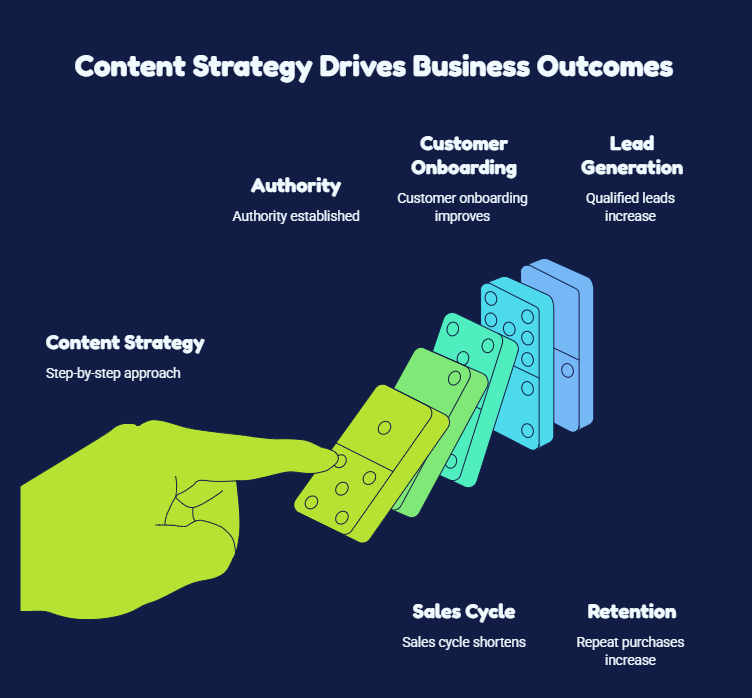
Step 1: Start With the Business Outcome
The first question should not be, “What should we publish?” It should be, “What should change in the business if our content succeeds?”
Possible business outcomes include:
- Generating qualified leads
- Increasing product or service enquiries
- Supporting a new market entry
- Reducing dependence on paid acquisition
- Shortening the sales cycle
- Improving customer onboarding
- Increasing retention or repeat purchases
- Establishing authority in a specialized category
Choose one primary outcome for the strategy. Secondary benefits are welcome, but they should not obscure the central purpose.
For example, “increase website traffic” is incomplete because traffic is an intermediate result. A more useful objective would be: “Increase qualified organic visits to our commercial topic clusters and convert more of those visitors into consultation requests.”
A practical objective can follow this structure:
Help [specific audience] solve [important problem] through [distinct content value], so they are more likely to [meaningful action], contributing to [business result].
This formulation forces the strategy to connect audience value with commercial value. Strong content marketing requires both. Content that serves only the business becomes promotion. Content that serves the audience but has no relationship to the business may attract attention without producing useful outcomes.
Step 2: Define a Specific Audience
“Business owners,” “marketers,” and “online shoppers” are not precise audiences. They are broad populations containing people with different problems, knowledge levels, budgets, and motivations.
A useful audience definition should include:
- Role or situation
- Primary objective
- Most important obstacles
- Existing level of knowledge
- Criteria used to evaluate solutions
- Sources already trusted
- Questions asked before taking action
- Risks or objections that delay a decision
Do not rely entirely on imagined personas. Use evidence from sales calls, customer interviews, support tickets, on-site search, reviews, community discussions, search queries, and analytics. The language people use to describe a problem is often more valuable than a polished internal description of that problem.
It is also helpful to separate the user from the buyer. In B2B markets, the person who consumes the content may recommend a solution but lack purchasing authority. Your strategy may need educational content for practitioners, financial justification for decision-makers, and implementation material for internal stakeholders.
The objective is not to describe every possible reader. It is to identify the audience whose attention has the greatest strategic relevance.
Step 3: Map Problems Across the Decision Journey
People need different information at different stages of a decision. A reader who has just recognised a problem is not ready for the same content as someone comparing vendors.
A simple journey model can include:
| Stage | Audience question | Suitable content |
| Discovery | What is happening, and why does it matter? | Educational articles, research, explainers, trend analysis |
| Understanding | How does this problem work? | In-depth guides, frameworks, expert commentary, webinars |
| Evaluation | Which approach is appropriate? | Comparisons, checklists, case studies, solution guides |
| Validation | Can I trust this company or method? | Evidence, methodology pages, testimonials, detailed case studies |
| Action | What should I do next? | Service pages, demos, consultations, trials, buying guides |
| Retention | How can I get more value after purchase? | Onboarding resources, tutorials, knowledge bases, advanced guidance |
This map prevents a common imbalance: creating large amounts of introductory content while leaving high-intent readers without the evidence needed to make a decision.
For each stage, record the audience’s central question, emotional concern, desired outcome, and logical next step. That turns a collection of topic ideas into a coherent information journey.
Step 4: Establish a Content Thesis
A content thesis defines the territory the brand intends to own intellectually. It identifies the problem the brand will discuss repeatedly, the audience it will serve, and the perspective that will make its work recognizable.
Consider two companies publishing about the same broad subject. One summarises common advice. The other combines original experience, clear reasoning, examples, and a consistent point of view. The second company is more likely to become memorable because it is contributing interpretation, not merely information.
Your content thesis should explain:
- The subject area in which the brand has credible knowledge
- The recurring audience problem it is qualified to address
- The assumptions or practices it is willing to question
- The principles that guide its recommendations
- The evidence it can contribute through experience, data, or analysis
For a link-building marketplace, for example, the thesis should be more specific than “we write about SEO.” It might focus on transparent publisher evaluation, editorial relevance, campaign economics, and sustainable authority building. That territory supports the business while still offering readers meaningful educational value.
This is where originality begins. Unique content is not achieved by replacing words in an existing article. It comes from a distinct selection of problems, evidence, examples, and conclusions.
Step 5: Audit Existing Content and Capabilities
Before creating more content, understand what already exists.
A content audit should examine:
- Topic and target audience
- Search intent
- Current organic visibility
- Traffic and engagement
- Backlinks and referring domains
- Conversions or assisted conversions
- Accuracy and freshness
- Overlap with other pages
- Internal links
- Appropriate next action
Classify each asset using clear actions:
- Keep: The content remains accurate, useful, and strategically relevant.
- Improve: The topic is valuable, but the page needs stronger evidence, structure, depth, or optimization.
- Consolidate: Several pages compete for the same intent and should become one stronger resource.
- Redirect: The page has value or links but no longer deserves a separate destination.
- Remove: The content is inaccurate, irrelevant, or too weak to justify maintaining.
The audit should also assess operational capability. A strategy that requires weekly research reports, daily videos, and an expert newsletter will fail if the team can reliably produce only two strong articles per month.
Capacity is a strategic constraint. A realistic plan protects quality and makes consistency sustainable.
Step 6: Research Search Demand and Audience Language
Keyword research is valuable, but it should come after the audience and business decisions. Otherwise, search volume can pull the strategy toward popular topics that have little commercial or intellectual relevance.
Evaluate a potential topic using several dimensions:
- Audience relevance: Does the topic address a consequential problem for the chosen audience?
- Intent: What is the searcher trying to understand, compare, accomplish, or purchase?
- Business alignment: Can the business credibly help after answering the question?
- Authority potential: Can the brand add experience, evidence, or analysis that is difficult to imitate?
- Conversion proximity: How close is the topic to a meaningful commercial action?
- Durability: Will the content remain useful, or does it require frequent updates?
Review search results manually. Look at the dominant page types, the depth of existing coverage, repeated subtopics, unanswered questions, and the standard of evidence. Search results reveal what search engines currently interpret as relevant, but they should not become a template to copy.
Google’s guidance on creating helpful, reliable, people-first content makes the central principle clear: content should primarily benefit people rather than exist to manipulate rankings. Its SEO Starter Guide also recommends original, useful, current content written with readers’ likely search terms in mind.
Use search data to understand demand. Use expertise to decide what deserves to be said.
Step 7: Build Topic Pillars and Content Clusters
A strong content marketing strategy organizes topics into a connected knowledge structure.
Begin with several core pillars that sit at the intersection of:
- Audience importance
- Business relevance
- Brand expertise
- Search opportunity
Each pillar can then support a cluster of narrower questions. For example:
Pillar: Content Marketing
- How to build a content marketing strategy
- Content audits
- Editorial workflows
- Content briefs
- Content distribution
- Measuring content performance
Pillar: Link Building
- Backlink quality
- Guest posting strategy
- Anchor text planning
- Publisher evaluation
- Link insertion
- Campaign reporting
The pillar page provides broad orientation. Cluster pages answer narrower questions in greater depth. Internal links connect related pages according to reader need, not simply keyword convenience.
This architecture improves navigation, reduces topic duplication, and helps a site develop depth around subjects that matter. It also makes planning easier because each new article has a defined role within a larger body of knowledge.
The same principle applies to off-site distribution. When a team needs to find relevant publisher websites, it should assess topical alignment, audience fit, editorial quality, and placement context instead of relying on a single authority metric. The publisher should strengthen the relationship between the subject, the reader, and the destination page.
Step 8: Set Editorial Standards Before Scaling Production
Content quality should not depend entirely on the individual writer. A documented editorial standard creates consistency without making every article sound identical.
Your standard should address:
- Audience and search intent
- Required depth and scope
- Evidence and source quality
- Brand voice
- Examples and original insight
- Headline and subheading structure
- Keyword usage
- Internal and external links
- Fact-checking
- Editing and approval
- Calls to action
- Update requirements
Every article should begin with a content brief. A useful brief includes the primary keyword, supporting topics, reader problem, intended outcome, content angle, competing pages, required evidence, internal-link opportunities, and the next action for the reader.
The brief should guide reasoning, not prescribe filler. Writers need enough structure to satisfy the strategic purpose and enough freedom to produce a coherent argument.
Businesses without sufficient in-house editorial capacity can use professional content writing services to support research, drafting, optimization, and quality control. The external team should still work from the same strategy and content brief. Outsourcing production should expand execution capacity without outsourcing the brand’s judgment.
Step 9: Match the Format to the Reader’s Task
The best content format is the one that helps the reader complete the task with the least unnecessary friction.
- Use a guide when the subject requires sequence and explanation.
- Use a checklist when the reader needs execution support.
- Use a comparison when the reader is evaluating alternatives.
- Use a case study when proof and context matter.
- Use a video when demonstration is more efficient than description.
- Use a calculator or template when the reader needs to apply information.
- Use original research when the market lacks dependable evidence.
Do not adopt formats merely because they are fashionable. A podcast without a distribution advantage or an interactive tool without a meaningful use case consumes resources without necessarily improving results.
Format is a functional decision. It should follow the information problem.
Step 10: Design Distribution Before Publication
Publishing is not distribution. A strong article can remain invisible if the strategy ends when the page goes live.
A balanced distribution model uses three channel types:
Owned channels
These include your website, email list, customer community, and social profiles. Owned channels provide direct access to an audience, although reach still depends on trust and participation.
Earned channels
These include editorial mentions, backlinks, guest contributions, expert quotations, partnerships, and organic sharing. Earned distribution can introduce the content to relevant audiences and strengthen the authority of the destination page.
Well-managed guest posting services are most effective when they place useful expertise before an appropriate audience and create a contextually relevant path to a deeper resource. The purpose is not to manufacture isolated links. It is to connect credible ideas, reputable publishers, and valuable destination content.
Similarly, niche edit services can connect a relevant resource to an established article that already addresses the same subject. The placement should add genuine explanatory value for the reader. A link that does not fit the surrounding discussion may exist technically, but it contributes little to a credible content strategy.
Paid channels
Paid search, social promotion, sponsorships, and content syndication can accelerate reach. Paid distribution is particularly useful when the content supports a defined offer, audience, and conversion path.
Create a distribution checklist for every significant asset. Identify potential contributors, customers, communities, newsletters, publishers, and internal teams before publication. Distribution works better when it is designed into the content rather than added as an afterthought.
Step 11: Create a Repeatable Production Workflow
A content marketing plan needs an operating system.
A typical workflow may include:
- Topic validation
- Brief approval
- Research
- Drafting
- Subject-matter review
- Editorial review
- SEO review
- Design or media production
- Final approval
- Publication
- Distribution
- Performance review
- Scheduled update
Assign one accountable owner to each stage. Define what must be true before work moves forward. For example, a draft should not enter editing until sources are documented, required sections are complete, and factual claims have been checked.
The editorial calendar should then record:
- Working title
- Content pillar
- Audience and journey stage
- Primary keyword
- Format
- Owner
- Current status
- Publication date
- Distribution channels
- Conversion action
- Review date
Cadence should reflect capacity. Two authoritative pieces supported by deliberate distribution can create more value than eight shallow posts published to satisfy a schedule.
Step 12: Connect Content to Meaningful Measurement
Measurement should reflect the job assigned to each asset. An introductory guide and a service comparison should not be judged by identical standards.
Use a layered measurement model:
| Measurement layer | Useful indicators |
| Visibility | Search impressions, rankings, referral reach, qualified page views |
| Engagement | Engaged sessions, scroll depth, return visits, newsletter subscriptions |
| Authority | Relevant backlinks, referring domains, brand mentions, expert citations |
| Demand | Demo requests, enquiries, resource downloads, account registrations |
| Revenue | Qualified pipeline, assisted conversions, sales, customer value |
| Efficiency | Cost per qualified lead, production cost, time to publish, content reuse |
Do not treat every available metric as a key performance indicator. A KPI should indicate progress toward the chosen business outcome.
Google Analytics allows important user actions to be marked as key events. For a lead-generation strategy, these might include a completed enquiry form, consultation booking, or qualified account registration. Tracking meaningful actions makes it possible to distinguish content that merely attracts visits from content that advances a business objective.
Attribution will never be perfect. A reader may discover a brand through search, return through email, read a case study, and later convert through a direct visit. Use several forms of evidence, including analytics, CRM data, sales feedback, customer interviews, and assisted conversion paths.
The goal is not mathematical certainty. It is better decision-making.
Step 13: Review, Update, and Reallocate
A strategy is a living system. Audience behavior changes, competitors improve, search results evolve, and business priorities shift.
Conduct a structured review every quarter. Ask:
- Which topic clusters are gaining relevant visibility?
- Which pages attract the right audience but fail to produce a next action?
- Which assets contribute to leads or sales conversations?
- Where are readers leaving because the content does not answer the next question?
- Which pages have earned credible links or citations?
- Which subjects no longer support the strategic objective?
- Which content should be updated, expanded, consolidated, or retired?
Reallocation is an essential part of strategy. If one cluster creates qualified demand while another produces only superficial traffic, the next plan should reflect that evidence.
Optimisation is not endless adjustment to headings and keywords. It includes changing topics, formats, distribution channels, offers, workflows, and even assumptions about the audience.
A Practical 90-Day Content Marketing Plan
The following framework can help a business move from scattered publishing to a documented and operational strategy.
Days 1 to 15: Establish Direction
- Choose the primary business outcome.
- Define the main audience using customer and sales evidence.
- Map audience problems across the decision journey.
- Write the content thesis and editorial principles.
- Select the metrics that will indicate progress.
Days 16 to 30: Build the Foundation
- Audit existing content.
- Research search demand and audience language.
- Identify three to five core topic pillars.
- Map supporting content clusters.
- Document the production and approval workflow.
Days 31 to 60: Create Strategic Assets
- Prioritise content according to audience value and business relevance.
- Prepare detailed briefs.
- Create or improve foundational pillar pages.
- Produce supporting articles for important subtopics.
- Add useful internal links and clear next actions.
Days 61 to 90: Distribute and Learn
- Promote key assets through owned channels.
- Pursue relevant editorial mentions, contributions, and partnerships.
- Repurpose strong ideas for email and social distribution.
- Measure visibility, engagement, authority, and key events.
- Record early findings and revise the next 90-day plan.
Ninety days may not be enough to demonstrate the full commercial value of an organic content program. It is enough to create direction, establish operating discipline, publish foundational assets, and begin collecting useful evidence.
Common Content Marketing Strategy Mistakes
Treating keywords as the strategy
Keywords reveal demand, not business priority or editorial value. They are inputs to strategic judgment.
Trying to address everyone
Broad content often becomes generic because it cannot reflect the context of any specific audience. Relevance requires exclusion.
Confusing publication frequency with consistency
Consistency means delivering a dependable standard and perspective. It does not require publishing weak content at arbitrary intervals.
Creating without a distribution plan
Organic discovery can take time. Distribution should be assigned resources and ownership just as production is.
Measuring traffic without examining intent
A small number of relevant readers may be worth more than a large number of visitors who will never need the product or service.
Copying competitors instead of developing insight
Competitor research can reveal market expectations and coverage gaps. It cannot supply your experience, evidence, or point of view.
Failing to maintain successful content
High-performing assets deserve continued attention. Updating examples, improving explanations, adding evidence, and strengthening internal links can extend their useful life.
Content Marketing Strategy Template
Use this concise framework to document the strategy:
- Business outcome: What measurable result should content support?
- Primary audience: Whose problem matters most to that result?
- Audience problem: What consequential issue will the content help solve?
- Content thesis: What territory and perspective will the brand own?
- Topic pillars: Which core subjects connect audience need, expertise, and business value?
- Journey coverage: What information is required from discovery through action and retention?
- Formats: Which formats best help the audience complete each task?
- Distribution: Which owned, earned, and paid channels will create discovery?
- Operations: Who researches, creates, reviews, approves, publishes, and updates the work?
- Measurement: Which indicators connect content performance to the chosen outcome?
- Review cycle: When will the strategy be evaluated and resources reallocated?
If the team cannot answer these questions clearly, adding more topics to the calendar is unlikely to solve the underlying problem.
How Backlinkrs Helps Turn Content Strategy Into Authority
A content marketing strategy determines what a business should communicate and why. Backlinkrs supports the next layer by helping businesses, agencies, and marketers connect strong content with relevant editorial opportunities.
Through the Backlinkrs publisher marketplace, users can evaluate publisher websites according to factors such as niche, traffic, authority metrics, link type, editorial conditions, and pricing. This makes publisher selection part of the strategic process instead of treating every backlink as interchangeable.
Backlinkrs also brings content production and placement into one coordinated workflow. Professional article writing is included with every guest post order at no additional cost, helping ensure that the article, anchor text, publisher, and destination page support the same campaign objective. Businesses planning wider campaigns can also explore structured link-building packages according to their authority goals, niche, and budget.
The objective is not to place links indiscriminately. It is to build contextually relevant connections between useful content, appropriate publishers, and pages that deserve greater visibility. That approach allows content development and authority building to reinforce one another.
Final Thoughts
An effective content marketing strategy does more than organise production. It determines where a business will concentrate its knowledge, which audience it intends to serve, what intellectual value it will contribute, and how that contribution will support a commercial outcome.
The strongest strategies balance discipline with learning. They begin with explicit choices, translate those choices into a realistic content marketing plan, and then improve through evidence. They do not chase every keyword, imitate every competitor, or publish merely to remain active.
Content becomes strategically valuable when each asset strengthens a larger system of relevance, authority, and trust. Build that system deliberately, distribute it intelligently, and measure it according to the business change it was created to produce.
FAQs
The key elements are a measurable business objective, a clearly defined audience, documented audience problems, a distinct content thesis, organized topic pillars, editorial standards, a distribution model, a production workflow, and performance metrics. Together, these elements explain why content exists and how it will create value.
A content strategy defines the audience, purpose, principles, and value behind the content. A content marketing plan translates those decisions into topics, formats, campaigns, workflows, distribution activities, and measurement. The strategy establishes direction, while the plan organizes execution.
There is no universal publishing frequency. The appropriate cadence depends on audience demand, competitive conditions, available expertise, production capacity, and distribution resources. A sustainable schedule of high-quality work is more valuable than a high-volume schedule the team cannot maintain.
The timeline depends on the starting authority of the website, market competition, content quality, distribution, sales cycle, and chosen goals. Early engagement or lead indicators may appear before substantial organic growth. Evaluate progress in stages rather than expecting one fixed deadline.
SEO helps a business understand search demand, align pages with user intent, improve discoverability, and organise information clearly. It is a distribution and accessibility discipline within the wider strategy. SEO cannot replace expertise, originality, useful content, or a relevant commercial proposition.
Measure each asset according to its role. Use visibility and engagement for discovery content, qualified enquiries and assisted conversions for decision-stage content, and adoption or retention indicators for customer content. Connect these measures to the primary business outcome whenever possible.