

SEO Statistics for 2026: Rankings, Traffic and Search Trends
Search is not disappearing in 2026. It is becoming larger, more fragmented, and less predictable.
Google still processes trillions of searches and holds more than 90% of the worldwide search engine market. At the same time, AI Overviews, AI Mode, visual search, answer engines, and zero-click results are changing what visibility means. A page can earn more impressions without receiving more clicks. A brand can be cited by an AI assistant without ranking for the same query. A number-one organic position can remain commercially valuable while producing a smaller share of available traffic than it once did.
These conditions make SEO statistics more useful, but also easier to misuse. Figures from different years, countries, devices, datasets, and methodologies are often presented together as though they describe one universal search market. They do not.
This guide brings together current SEO stats and search engine statistics available through August 2026. Each figure is dated and linked to its original or primary research source wherever possible. More importantly, the article explains what the numbers mean for content, authority, traffic forecasting, and search strategy.
Important Note About the Data
There is no single database that measures every search, ranking, click, backlink, and AI citation across the entire web. The statistics in this article come from several kinds of sources:
- First-party platform disclosures from Google and Alphabet
- Clickstream panels from Similarweb, Datos, and research partners
- Market-share tracking from Statcounter
- Aggregated Google Search Console datasets
- SEO-tool indexes from Ahrefs and Semrush
- Observational research from Pew Research Center
The measurement date matters. A statistic published in 2026 may analyze data collected in 2025. A historical benchmark can remain useful, but it should not be described as a new 2026 measurement.
Correlation also does not prove causation. If pages with more referring domains tend to rank better, that does not mean every additional backlink will improve a ranking. Strong pages may earn links because they are useful, and strong websites may perform well for many connected reasons.
The figures below should support judgment, not replace it.
Key SEO Statistics for 2026 at a Glance
| SEO statistic | Figure | Measurement or publication period |
|---|---|---|
| Searches processed by Google annually | More than 5 trillion | Google disclosure, 2025 |
| Google searches that are new each day | 15% | Google disclosure, 2025 |
| Google’s worldwide search market share | 91.31% | Statcounter, July 2026 |
| Bing’s worldwide search market share | 4.47% | Statcounter, July 2026 |
| Google’s worldwide mobile search share | 95.82% | Statcounter, July 2026 |
| Google’s worldwide desktop search share | 86.12% | Statcounter, July 2026 |
| Google Lens searches per month | More than 25 billion | Google disclosure, May 2025 |
| Lens searches with commercial intent | One in four | Google disclosure, May 2025 |
| AI Overviews monthly active users | More than 2.5 billion | Google disclosure, June 2026 |
| AI Mode monthly active users | More than 1 billion | Google disclosure, June 2026 |
| Google searches ending without a click | 68.01% | SparkToro and Similarweb, first four months of 2026 |
| Traditional-result clicks when an AI summary appeared | 8% of visits | Pew Research Center, March 2025 behavior data |
| Traditional-result clicks without an AI summary | 15% of visits | Pew Research Center, March 2025 behavior data |
| Clicks on sources inside an AI summary | 1% of visits | Pew Research Center, March 2025 behavior data |
| Estimated CTR reduction for position one when an AI Overview appeared | 58% | Ahrefs, December 2025 data published in 2026 |
| Typical whole-site organic CTR | Approximately 1% to 2% | Ahrefs, 422,421 sites, June 2026 |
| Traffic Google sent compared with ChatGPT | 190 times more | Ahrefs Web Analytics, 76,000 sites, February 2026 |
| Pages receiving no estimated Google traffic | 96.55% | Ahrefs, approximately 14 billion pages, 2023 study |
| Newly published pages reaching the top ten within one year | 1.74% in the broad sample | Ahrefs, 2025 study |
| Top-ten pages more than three years old | 72.9% | Ahrefs, 1.3 million US keywords, 2025 study |
| Average age of a number-one ranking page | Five years | Ahrefs, 2025 study |
| AI citations also appearing in Google’s top ten | 12% on average | Ahrefs, 15,000 prompts, 2025 study |
| Top-ranking pages containing some detected AI assistance | 86.5% | Ahrefs, 600,000 pages, 2025 study |
These headline numbers describe a market with three simultaneous characteristics: enormous search demand, declining click availability, and rising competition for trusted visibility.
Search Volume and Market Share Statistics
1. Google Processes More Than 5 Trillion Searches Per Year
Google stated in 2025 that it sees more than 5 trillion searches annually. Dividing that figure across a year gives an indicative average of more than 13.7 billion searches per day.
The figure is useful because it challenges the idea that AI assistants have already replaced conventional search. Search behavior is changing, but Google’s query volume remains immense.
The commercial lesson is not that every business has access to trillions of opportunities. Most queries will never be relevant to a specific brand. The opportunity lies in identifying the small portion of search demand where audience need, expertise, and commercial value overlap.
2. Fifteen Percent of Daily Google Searches Are New
Google also says that 15% of searches made each day have never been searched before.
This statistic explains why keyword databases can never capture the complete search market. Search demand is not a fixed inventory. New products, events, language, combinations, and questions continuously create new queries.
For SEO teams, this supports a strategy built around subjects and audience problems rather than an inflexible list of exact-match keywords. A well-developed topic can rank for variations that no tool predicted individually.
3. Google Held 91.31% of Worldwide Search in July 2026
Statcounter’s worldwide data placed Google at 91.31% of search engine market share across devices in July 2026. Bing followed at 4.47%, Yahoo at 1.24%, Yandex at 1%, DuckDuckGo at 0.65%, and Baidu at 0.5%.
Google therefore remains the primary search platform for most international SEO programs. However, the remaining share is not commercially irrelevant. Bing can matter in desktop-heavy markets, Yandex has regional importance, and Baidu operates within a distinct Chinese search environment.
Search strategy should follow the location, device use, and behavior of the actual audience rather than global averages alone.
4. Google’s Share Was 95.82% on Mobile but 86.12% on Desktop
The device split is strategically important. Statcounter measured Google at 95.82% of worldwide mobile search in July 2026, while Bing held only 0.61%.
On desktop, Google’s share was 86.12%, while Bing reached 8.84%.
This does not mean businesses should build completely separate SEO programs for each device. It means audience composition can change the value of a platform. A B2B company serving office-based professionals may find Bing more relevant than a mobile-first consumer brand would.
5. Google Lens Handles More Than 25 Billion Queries Per Month
Search is no longer limited to typed words. Google reported in May 2025 that Lens handled more than 25 billion queries every month, up from 20 billion the previous October. One in four Lens searches had commercial intent.
Visual search changes the assets SEO teams must optimize. High-quality original images, descriptive surrounding text, clear product information, useful alt text, and technically accessible media can all affect how content participates in visual discovery.
For ecommerce, travel, food, home, fashion, and product-led businesses, visual search is already part of search strategy rather than a future experiment.
Organic Ranking Statistics
6. Only 1.74% of Newly Published Pages Reached the Top Ten Within a Year
An Ahrefs study followed one million random newly discovered URLs and found that only 1.74% reached Google’s top ten within one year.
The broad sample included many types of pages, so Ahrefs also applied a narrower filter to two million non-empty English pages. Under that definition, 6.11% reached the top ten within a year.
Both figures point in the same direction: publication alone rarely produces competitive visibility. New pages need a relevant query, satisfied intent, accessible technical foundations, credible information, internal support, and often external authority.
7. Among Pages That Ranked, 40.82% Reached the Top Ten Within One Month
The same study found that 40.82% of the pages that eventually ranked in the top ten did so within their first month.
This does not mean every page should rank within 30 days. It suggests that early fit can be informative. When a page earns initial visibility but stalls below the top positions, the issue may involve authority, completeness, search intent, or competitive strength. When a page receives no meaningful impressions, the topic choice, indexation, or relevance may need reconsideration.
8. Nearly 73% of Top-Ten Pages Were More Than Three Years Old
Across 1.3 million US keywords, Ahrefs found that 72.9% of pages appearing in Google’s top ten were more than three years old. Only 13.7% were less than one year old.
The average number-one ranking page was five years old.
Age itself is not necessarily the cause of ranking. Older successful pages have had more time to earn links, accumulate engagement, establish historical relevance, and receive updates. The practical lesson is that SEO rewards durable assets. A page should be planned as something to maintain, not something to publish and abandon.
9. Most Indexed Content Receives No Measurable Search Traffic
In a 2023 analysis of approximately 14 billion pages, Ahrefs estimated that 96.55% received no organic traffic from Google. Another 1.94% received between one and ten visits per month.
This is a historical study rather than a fresh 2026 measurement, but it remains an important baseline. The web contains far more pages than search demand can support. Many pages target no meaningful query, fail to match intent, lack links, duplicate existing information, or remain technically inaccessible.
The statistic does not argue against content creation. It argues against undirected content creation. Every important page should have a defined audience, purpose, discovery path, and relationship to the wider content marketing strategy.
Traffic and Click-Through Statistics
10. A Typical Website’s Organic CTR Is Approximately 1% to 2%
Ahrefs analyzed anonymized Google Search Console data from 422,421 websites for June 2026. It concluded that a typical whole-site organic click-through rate falls between 1% and 2%.
This is a whole-site metric, not the CTR for position one. It divides all organic clicks by all recorded impressions, including low positions and queries where a site is only marginally visible.
Industry differences were substantial. Median CTR was 1.77% for news, 1.51% for finance, 1.33% for shopping, 1.15% for health, and 0.86% for business and industrial websites. A good benchmark is therefore not a universal percentage. It is performance relative to comparable sites and the direction of change over time.
11. Google Produced Nearly 40% of Website Traffic in an Ahrefs Panel
In a February 2026 study using Ahrefs Web Analytics data from 76,000 websites, Google accounted for 39.98% of measured website traffic. ChatGPT accounted for 0.21%.
Within that particular dataset, Google sent 190 times more traffic to websites than ChatGPT.
This is not a claim about every website on the internet. The panel contains sites using Ahrefs Web Analytics and may differ from the wider web. It nevertheless shows the current referral gap between traditional search and conversational AI.
AI visibility deserves attention, but abandoning conventional SEO would ignore the channel still delivering far more measurable visits.
12. More Than Two-Thirds of Google Searches Ended Without a Click
SparkToro’s analysis of Similarweb clickstream data reported that 68.01% of Google searches ended without a click during the first four months of 2026.
The researchers also compared this with earlier zero-click studies, but they explicitly warned that the historical panels used different users, devices, and providers. The exact trend line should therefore be interpreted cautiously.
The 2026 result itself captures an important structural change. Search visibility can create an impression, answer a question, influence brand recognition, or lead to a refined query without producing a website session.
SEO reporting must distinguish among rankings, impressions, clicks, qualified actions, and brand outcomes. Treating them as interchangeable hides what the search result actually accomplished.
AI Overviews and AI Search Statistics
13. AI Overviews Reached More Than 2.5 Billion Monthly Active Users
Google reported in June 2026 that AI Overviews had more than 2.5 billion monthly active users.
This scale makes AI-generated search results part of mainstream SEO. Businesses no longer need a separate philosophical debate about whether AI search matters. The operational question is how to remain a credible source when search results synthesize information before a user visits a website.
14. AI Mode Surpassed One Billion Monthly Users
In the same June 2026 disclosure, Google said AI Mode had passed one billion monthly users. Google also reported that AI Mode queries had more than doubled every quarter since launch.
Conversational interfaces allow longer, more specific, and iterative questions. A user can refine requirements without beginning a completely new search. This increases the importance of entities, clear factual relationships, complete explanations, original evidence, and content that can answer narrower follow-up questions.
15. Traditional Result Clicks Fell From 15% to 8% When an AI Summary Appeared
Pew Research Center analyzed 68,879 Google searches connected to browsing behavior from 900 US adults. Users clicked a traditional result on 15% of visits without an AI summary, compared with 8% when a summary appeared.
Only 1% of visits to pages with an AI summary produced a click on a source cited inside the summary. Users also ended their browsing session on 26% of pages with an AI summary, compared with 16% of pages containing only traditional results.
The behavior was observed in March 2025, before AI Overviews reached their 2026 scale. It should not be treated as a live universal CTR, but it provides direct evidence that AI summaries can change user behavior.
16. AI Overviews Correlated With a 58% Reduction in Position-One CTR
Ahrefs compared 150,000 informational keywords with AI Overviews against 150,000 informational keywords without them. Using aggregated Search Console data, it estimated that an AI Overview correlated with a 58% lower average CTR for the top-ranking page in December 2025.
For the keywords that later triggered AI Overviews, average position-one CTR fell from 7.3% in December 2023 to 1.6% in December 2025. Ahrefs modeled what the CTR might have been without the AI Overview to estimate the 58% effect.
Because this is an observational, modeled comparison, it should not be interpreted as a guaranteed loss for every query. Its strategic meaning is still significant: ranking position alone is becoming a weaker traffic forecast when the search result contains an answer layer above the organic listings.
17. Only 12% of AI Assistant Citations Also Ranked in Google’s Top Ten
Ahrefs ran 15,000 long-tail prompts through ChatGPT, Gemini, Copilot, and Perplexity, then compared their citations with search results. On average, only 12% of cited URLs appeared in Google’s top ten for the same prompt.
Perplexity was the closest to conventional search, with 28.6% of its citations appearing in Google’s top ten. Across the other assistants, the overlap was around 8%.
Google’s own AI Overviews behaved differently. Ahrefs found that 76% of AI Overview citations came from pages in Google’s top ten.
The distinction matters. Visibility in Google AI Overviews remains closely connected to conventional rankings, while visibility in independent AI assistants may depend on a different retrieval and citation process.
18. AI-Assisted Content Appeared Across 86.5% of Top-Ranking Pages
Ahrefs used its content detector on 600,000 pages ranking in Google’s top 20. It classified 4.6% as pure AI, 13.5% as pure human, and 81.9% as a mixture. In total, 86.5% contained some detected AI-generated material.
This statistic needs a strong caveat. AI detectors are probabilistic and can produce false positives. The study also grouped light editing assistance with much heavier AI use.
The useful conclusion is not that automation guarantees rankings. The study found almost no correlation between the percentage of detected AI content and ranking position. Quality, accuracy, originality, experience, intent satisfaction, and editorial control remain more meaningful than the mere presence or absence of an AI tool.
Backlink and Authority Statistics
19. More Than 92% of Consistently Ranking New Domains Had a Backlink
Semrush studied 28,000 newly observed domains over 13 months. Among the domains that remained in the top 100 throughout the study, 92.3% had at least one backlink.
Among domains that failed to reach the top ten, 55.1% had no backlinks. The top-performing group also increased its median number of referring domains while the broader qualified group remained comparatively flat.
The data was collected from 2021 to 2022 and published in 2023, so it is a historical benchmark. It also shows association, not proof that backlinks alone produced the rankings.
The practical lesson remains credible: new websites often need external discovery and authority in addition to on-site optimization. A thoughtful guest posting strategy can support that objective when publisher relevance, editorial quality, and destination value guide the campaign.
20. Brand Mentions Correlated More Strongly With AI Visibility Than Backlinks
Ahrefs studied 75,000 brands and found that brand mentions across the web had a 0.664 correlation with visibility in AI Overviews. Branded anchor text followed at 0.527, while backlink count had a weaker 0.218 correlation.
Brands in the highest quartile for web mentions averaged more than ten times as many AI Overview mentions as brands in the next quartile.
This does not make backlinks irrelevant. It suggests that modern authority is broader than a link count. Search and AI systems can interpret how frequently a brand is discussed, the subjects associated with it, the language used around it, and whether credible sources repeatedly place it within a relevant context.
For authority building in 2026, the strategic unit is increasingly the credible external reference. Some references are linked, some are unlinked, and the strongest campaigns often earn both.
What the 2026 SEO Stats Actually Mean
Statistics become strategically useful only when they change a decision.
Search Demand Is Growing While Click Supply Is Shrinking
Google processes more than five trillion annual searches, and its AI features encourage users to ask more complex questions. Yet zero-click behavior and AI summaries reduce the percentage of searches that send visits to websites.
This creates a decoupling between visibility and traffic. Impressions can rise while clicks remain flat or fall. SEO teams must measure whether the brand appeared, whether the page was cited, whether branded searches increased, and whether the clicks that did arrive were commercially valuable.
Ranking First Is Valuable but No Longer Describes the Whole Result
Position one still matters. It can influence visibility in conventional results and Google AI Overviews. However, the actual layout may include advertisements, maps, products, video, discussions, snippets, and AI-generated answers before the first traditional listing.
Traffic forecasts should therefore use query-specific SERP features and recent Search Console CTR, not a universal position-based curve.
Durable Content Has an Advantage
Nearly 73% of top-ten pages in the Ahrefs study were more than three years old. This supports a portfolio approach to content. Foundational pages should be researched, maintained, internally linked, externally supported, and updated when the subject changes.
Businesses that need scalable editorial execution can use professional content writing services, but production volume should not replace expertise or strategic focus. The page must contribute something worth preserving.
Authority Is Moving From Links Alone to Web-Wide Reputation
Backlinks remain useful for discovery, context, referral traffic, and authority. AI visibility research also points toward the importance of brand mentions and descriptive branded anchors.
This favors campaigns that integrate digital PR, expert contributions, publisher relationships, research, guest articles, and useful destination content. Isolated link placement without a coherent brand narrative captures only part of the opportunity.
Search Optimization and AI Visibility Are Related but Not Identical
Google AI Overviews draw heavily from top-ten results, but independent AI assistants cite many pages that do not rank for the same prompt. Businesses need strong technical SEO and conventional rankings while also making their expertise legible across the wider web.
That means clear entity information, consistent brand descriptions, original facts, quotable insights, current content, and credible third-party references.
How to Use These SEO Statistics in a 2026 Strategy
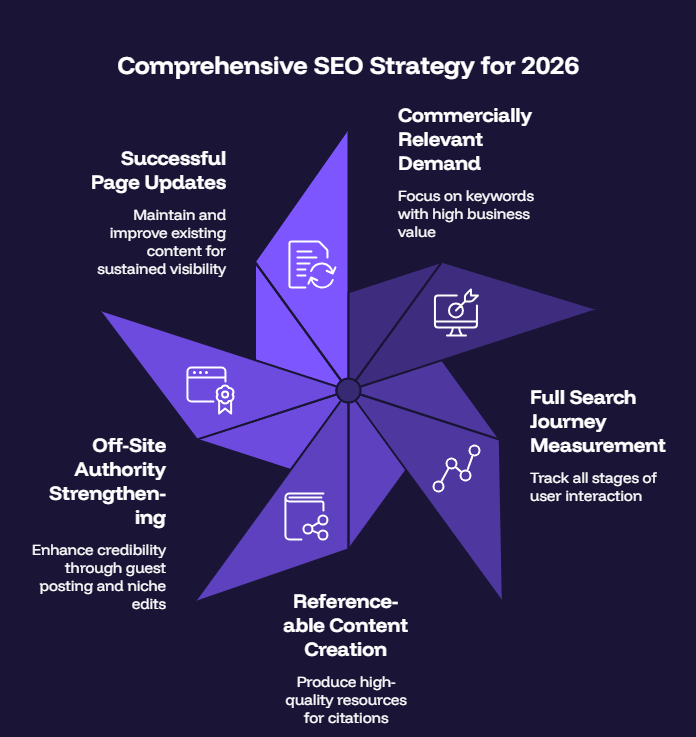
Build Around Commercially Relevant Demand
Do not chase a high-volume keyword solely because it is large. Consider search intent, AI Overview presence, available clicks, competitive strength, conversion proximity, and the business value of a qualified visitor.
Measure the Full Search Journey
Track:
- Search impressions
- Organic clicks
- Query-level CTR
- Landing-page engagement
- Qualified leads and sales
- Assisted conversions
- Branded search growth
- Referral traffic
- Backlinks and referring domains
- Brand mentions
- AI citations where measurable
No single metric can represent the full contribution of search.
Invest in Content That Can Become a Reference
Statistics pages, original research, practical frameworks, tools, templates, expert analysis, and well-supported guides give other publishers a reason to cite the website.
The objective is not simply to publish an answer. It is to create the resource other answers depend on.
Strengthen Relevant Off-Site Authority
Use selective guest posting services to place real expertise before relevant audiences. Use niche edit services when an established article has a genuine contextual reason to reference a useful resource. In both cases, publisher quality and topical fit matter more than a metric viewed in isolation.
Teams can also find relevant publisher websites through a structured marketplace, then compare niche, traffic, authority indicators, link conditions, and editorial requirements before selecting a placement.
Update Successful Pages Instead of Constantly Starting Over
Older pages dominate many search results, but age without maintenance is not a strategy. Review important pages for accuracy, intent changes, broken sources, outdated examples, internal-link opportunities, SERP changes, and new competitor evidence.
Protect existing visibility before allocating every resource to new production.
How Backlinkrs Supports Search Authority in 2026
The SEO statistics in this guide point toward a clear conclusion: visibility depends on more than publishing content and waiting. Strong pages need credible external context, relevant discovery, and a brand presence that extends beyond the website itself.
Backlinkrs helps businesses, agencies, and marketers explore publisher opportunities through the Backlinkrs publisher marketplace. Users can compare available websites using information such as niche, traffic, authority metrics, link type, editorial conditions, and pricing instead of treating every domain as equivalent.
Professional article writing is included with every guest post order at no additional cost. Each article is developed around the selected publisher, target page, anchor text, subject, and campaign requirements so that content creation and placement operate as one coordinated process.
Clients can select individual publisher placements or explore structured link-building packages according to their niche, authority goals, scale, and budget. The purpose is not to manufacture volume without context. It is to build relevant editorial connections that can contribute to referral traffic, brand recognition, backlinks, and broader web authority.
Final Thoughts
The most important SEO statistic for 2026 is not a single percentage. It is the widening gap between search activity and website traffic.
People are searching more, using more formats, and asking more complex questions. Google remains overwhelmingly dominant, but AI Overviews and AI Mode increasingly answer questions inside the search experience. Rankings still matter, yet the click attached to a ranking is less predictable. Backlinks still matter, yet brand mentions and broader web presence are becoming part of the authority picture.
SEO is therefore moving from a narrow rankings discipline toward a wider visibility system. Technical accessibility, useful content, search intent, brand authority, publisher relationships, citations, and conversion quality must be evaluated together.
The businesses that adapt will not abandon SEO. They will measure it more intelligently. They will create content worth citing, earn relevant third-party recognition, protect proven pages, and judge success by meaningful commercial outcomes rather than rankings alone.
Frequently Asked Questions
Yes. Google processes more than five trillion searches annually and remains the dominant worldwide search engine. However, zero-click results and AI answers mean rankings do not always generate the same level of traffic. Effective SEO now requires measuring visibility, clicks, citations, brand demand, and conversions together.
Statcounter measured Google’s worldwide search engine market share at 91.31% across devices in July 2026. Its share was higher on mobile at 95.82% and lower on desktop at 86.12%.
SparkToro’s analysis of Similarweb clickstream data found that 68.01% of Google searches ended without a click during the first four months of 2026. Zero-click estimates vary by methodology, country, device, and the definition of a completed search.
Pew Research Center observed fewer traditional-result clicks when an AI summary appeared, while Ahrefs estimated a 58% reduction in position-one CTR for informational queries with AI Overviews. The impact differs by query and industry, so websites should analyze their own Search Console data.
There is no fixed ranking timeline. In Ahrefs’ broad sample, only 1.74% of newly published pages reached the top ten within one year. Among pages that did rank, 40.82% reached the top ten in their first month. Competition, intent, site authority, content quality, links, and technical conditions all affect timing.
Backlinks remain relevant for discovery, referral traffic, context, and authority. Historical Semrush data found that most new domains maintaining rankings had at least one backlink. Newer AI visibility research also shows that brand mentions and branded anchors can matter alongside conventional link metrics.
AI-assisted content appears throughout current search results, but the use of AI alone does not guarantee performance. Accuracy, originality, experience, usefulness, intent satisfaction, and editorial oversight remain essential. AI-detection statistics should also be treated cautiously because detectors are probabilistic.
Ahrefs’ June 2026 data suggests that a typical whole-site organic CTR is approximately 1% to 2%. The correct benchmark varies by industry, authority, website size, query mix, device, ranking position, and SERP features.