What Are AI Backlinks? A Practical Guide to AI-Powered Link Building
Artificial intelligence is changing how marketers research keywords, create content, analyze competitors, and approach search engine optimization. Link building is no exception.
But the phrase AI backlinks can be misleading.
There is no fundamentally different class of backlink that becomes valuable simply because artificial intelligence was involved in creating or acquiring it. A backlink is still a link from one website to another.
What has changed is the process behind acquiring those links.
AI can help marketers discover relevant prospects, analyze backlink profiles, identify content opportunities, personalize outreach, and organize large amounts of research. Used properly, it can make link building more efficient. Used carelessly, it can simply make low-quality link building happen faster.
So, what exactly is an AI backlink? How does AI fit into modern link building? And can AI actually help you earn better backlinks?
Let’s take a closer look.
What Are AI Backlinks?
AI backlinks are backlinks acquired with the assistance of artificial intelligence tools or AI-powered link-building workflows.
The backlink itself is not a new SEO asset. The difference is in how the opportunity is discovered, evaluated, pursued, or supported.
For example, an AI-assisted link-building process could help you:
- Find websites relevant to your industry
- Analyze competitors’ backlink profiles
- Identify pages that may benefit from your content
- Discover content gaps
- Research potential link prospects
- Personalize outreach messages
- Develop content ideas
- Analyze campaign performance
- Monitor new and lost backlinks
This distinction is important because AI can improve the process of link acquisition, but it cannot manufacture genuine authority.
A link from a relevant publication is valuable because the publication chose to reference useful information. AI does not change that underlying relationship.
For readers who are new to the subject, our link-building strategy guide provides a broader explanation of how backlinks fit into SEO.
AI Backlinks vs. AI-Generated Backlinks
The terms are sometimes used interchangeably, but they can describe very different approaches.
AI backlinks generally refers to backlinks acquired through an AI-assisted process.
AI-generated backlinks can imply that software automatically creates links across websites, directories, comments, profiles, or other locations.
Those are not equivalent strategies.
An AI tool might help you identify 100 highly relevant publications. That is an intelligent use of automation.
An automated system that creates thousands of links on unrelated websites is a very different proposition.
The objective should not be to create as many links as possible.
The objective should be to identify and earn links that make sense for your website, your audience, and the publisher linking to you.
Google’s current spam policies specifically identify automated programs or services used to create links as an example of link spam. Google’s link spam policies
How Does AI Link Building Work?
AI can support almost every stage of a modern link-building campaign.
A practical workflow looks like this.
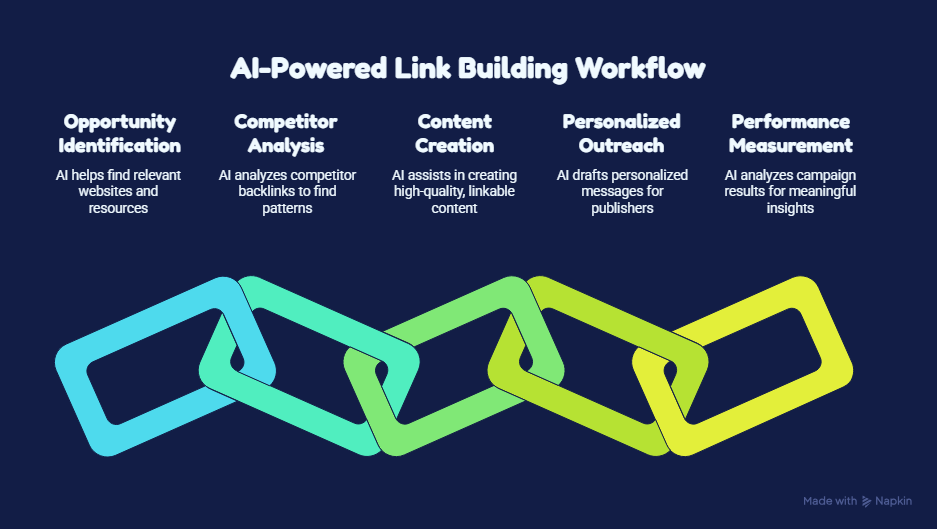
1. Find Relevant Link Opportunities
The first challenge in link building is not finding websites.
It is finding the right websites.
AI can process large amounts of information and help identify websites, publications, articles, and resources related to a specific topic.
For example, imagine you publish a detailed guide about technical SEO.
An AI-assisted research workflow could help identify:
- SEO publications
- Digital marketing websites
- SaaS blogs
- Industry publications
- Resource pages
- Relevant articles
- Websites covering technical SEO
- Publishers that regularly reference research
But relevance should remain the first filter.
A large list of websites is not necessarily a valuable prospect list.
A smaller list of highly relevant publishers can be much more useful.
2. Analyze Competitor Backlinks
Competitor backlink analysis is another area where AI can reduce research time.
Instead of asking only how many backlinks a competitor has, look at why those backlinks exist.
AI-assisted analysis can help identify:
- Websites linking to multiple competitors
- Topics that repeatedly attract backlinks
- Content formats that earn references
- Resource pages linking to competitors
- Publications covering your industry
- Patterns across competing backlink profiles
- Potential gaps in your own content
The objective is not to copy a competitor’s backlink profile.
It is to understand the underlying opportunity.
If three competing websites are being cited by industry publications because they published original research, the lesson may not be “get the same links.”
It may be:
Create better research that gives publishers a reason to cite you.
For a broader introduction to acquiring backlinks, see our link-building strategy guide.
3. Create Content Worth Linking To
This is where many AI-powered link-building strategies go wrong.
AI can produce content quickly.
But speed does not automatically create something worth linking to.
If producing original, link-worthy content is a bottleneck, a professional content writing service can help turn research, expertise, and campaign objectives into publishable assets.
A publisher has little reason to reference another generic article that repeats information already available across dozens of websites.
Strong linkable assets can include:
- Original research
- Industry surveys
- Unique datasets
- First-hand analysis
- Case studies
- Expert commentary
- Original frameworks
- Useful tools
- Calculators
- Detailed guides
- Visual resources
- Proprietary findings
The question to ask is:
Why would another website want to cite this page?
If the answer is simply “because it is well optimized for SEO,” the asset probably needs more substance.
If the answer is “because it contains data, analysis, or information that readers will not find elsewhere,” you have a much stronger foundation.
This is also where a broader content marketing strategy becomes important. Link building works better when the content being promoted has a clear purpose beyond acquiring links.
4. Personalize Outreach
Once you have good prospects and a worthwhile resource, you still need to communicate with publishers.
AI can help create first drafts of outreach messages based on:
- The publication’s subject matter
- Recent articles
- Existing resources
- Relevant content gaps
- The prospect’s audience
- Your own resource
But there is an important difference between personalization and inserting someone’s website name into a template.
Compare:
Hi, I found your website and thought our article would be a great addition.
with:
Your guide explains several ways marketers can evaluate organic growth, but the section on referring domains does not include a practical example. We recently published original research on that relationship that may be useful for readers evaluating link acquisition strategies.
The second message provides a reason for the recipient to care.
AI can help prepare the draft.
A human should decide whether the pitch actually makes sense.
5. Measure the Results
AI can also help analyze the performance of a link-building campaign.
Instead of measuring success only by the number of backlinks acquired, look at:
- Referring domains
- Relevance of acquired links
- Referral traffic
- Organic traffic
- Conversions
- Link placement
- Anchor-text distribution
- Lost backlinks
- Outreach response rates
- Content-level link acquisition
This produces a much more meaningful picture of campaign performance.
Our latest SEO statistics can also provide broader context when evaluating how link acquisition fits into the larger SEO landscape.
Can AI Create Backlinks Automatically?
AI can automate activities that may result in links being placed on websites.
That does not mean those links are valuable.
There is a major difference between automating legitimate research and outreach and automatically generating links for the purpose of manipulating rankings.
Examples of risky approaches can include:
- Automated blog-comment links
- Mass forum-profile links
- Large-scale directory submissions
- Automatically generated websites
- Link networks
- Mass-produced guest posts
- Pages created primarily to host links
These tactics focus on the existence of the link rather than its usefulness.
Google’s spam policies define link spam as creating links primarily to manipulate search rankings and specifically include automated link creation among examples. Google Search spam policies
The important principle is:
Automation does not make an unnatural link natural.
Are AI Backlinks Good for SEO?
AI-assisted backlinks can be good for SEO when they are relevant, useful, and acquired through legitimate link-building practices.
The value of the backlink comes from factors such as its relevance, context, source, and potential usefulness to the audience, not from the fact that AI was involved.
AI can make the process more efficient by helping marketers:
- Research prospects faster
- Analyze large datasets
- Find content opportunities
- Personalize outreach
- Identify patterns
- Monitor campaigns
But AI cannot replace the fundamentals of earning worthwhile links.
Google’s Search Essentials continue to emphasize established SEO practices and useful content. Google Search Essentials
Can AI-Generated Content Earn Backlinks?
Yes, AI-assisted or AI-generated content can earn backlinks, but only if it provides a genuine reason to be referenced.
AI itself does not give content a ranking advantage.
Google’s guidance states that its systems focus on the quality and usefulness of content rather than whether it was produced by AI or another method. At the same time, using AI to generate large quantities of content without adding value can fall under Google’s scaled content abuse policy. Google’s guidance on generative AI content
Consider two hypothetical articles.
Article A
10 SEO Tips for Beginners
The article contains familiar advice that hundreds of websites already cover.
Article B
An Analysis of 10,000 Search Results: How Internal Linking Correlates With Organic Visibility
The article contains original data, methodology, analysis, and findings.
Article B gives another publisher a much stronger reason to cite it.
The important distinction is not whether AI was used.
It is whether the content adds something worth referencing.
How to Use AI for Backlinks Without Sacrificing Quality
The strongest AI-assisted workflows keep humans responsible for judgment.
Use AI for Research
AI is useful for organizing large datasets, identifying patterns, categorizing prospects, and generating research questions.
Use AI to Develop Content Briefs
Instead of asking AI to write an article from scratch, use it to help identify:
- Important subtopics
- Missing perspectives
- Reader questions
- Competing content patterns
- Research opportunities
- Potential evidence
- Useful content formats
Then add original research, expertise, examples, and editorial judgment.
Use AI to Assist Outreach
AI can prepare initial outreach drafts, but each message should be reviewed for:
- Accuracy
- Relevance
- Personalization
- Tone
- Specificity
Use AI to Qualify Prospects
Do not evaluate a prospect solely by domain metrics.
Consider:
- Topical relevance
- Audience overlap
- Editorial quality
- Organic visibility
- Content quality
- Existing outbound links
- Link placement
- Website credibility
Keep Humans Responsible for Final Decisions
Before pursuing a backlink, ask:
Would this link make sense if search engines did not exist?
If the answer is yes, the opportunity is worth investigating.
If the answer is no, the tactic probably needs reconsideration.
AI Backlinks and Guest Posting
AI can also make it easier to research suitable publishers before exploring a guest posting marketplace where relevant placement opportunities can be evaluated.
AI can help with:
- Finding relevant publications
- Researching editorial requirements
- Developing article ideas
- Creating outlines
- Researching supporting information
- Personalizing pitches
- Organizing prospect data
But guest posting should not become a content-production assembly line.
Sending identical AI-generated articles to hundreds of unrelated websites may create volume, but it does not create a strong editorial strategy.
Effective guest blogging starts with relevance and usefulness.
The publication should benefit from the article.
Its readers should benefit from the information.
And any backlink should exist within a legitimate editorial context.
For a deeper look at the process, see our complete guide to guest blogging.
For businesses looking for a more structured approach, guest posting packages can simplify the process of selecting placements and managing campaigns.
What About Backlinks From AI Platforms?
There is another meaning of “AI backlinks” that has become increasingly relevant: links or citations that appear within AI-powered search experiences.
This is related to, but different from, AI-assisted link building.
A citation or supporting link shown in an AI-generated answer is not necessarily equivalent to a traditional backlink.
The broader question is:
How does a website become a source that AI systems consider useful enough to reference?
The answer is not to create thousands of artificial links.
It is to publish information that is useful, reliable, discoverable, and supported by strong SEO fundamentals.
Google’s current guidance for AI features in Search says existing SEO fundamentals remain relevant and that pages must be eligible to appear in Search to be eligible as supporting links in AI Overviews or AI Mode. Google’s guidance for AI features in Search
That makes traditional SEO and content quality more important, not less.
What Makes an AI-Assisted Backlink Valuable?
A useful way to evaluate a backlink is to look beyond the domain and examine the context.
Is the Website Relevant?
A link from a website closely related to your subject is generally more meaningful than a random link from an unrelated domain.
Is the Page Useful?
The page containing the link should serve a legitimate purpose for its readers.
Is the Link Contextually Appropriate?
Contextual placement matters particularly when considering a niche edit service, where an existing relevant article may provide a natural environment for a reference.
Is the Placement Editorial?
A genuine editorial reference is fundamentally different from a link inserted solely to manipulate rankings.
Could the Link Bring Qualified Visitors?
Referral traffic is an important but sometimes overlooked measure of link quality.
A link that introduces your business to genuinely interested readers has value beyond search rankings.
Common AI Backlink Mistakes
AI makes it easier to scale processes.
That is both its greatest advantage and its greatest risk.
1. Chasing Volume
Thousands of questionable links are not necessarily better than a handful of highly relevant editorial references.
2. Publishing Generic AI Content
If your article says essentially the same thing as dozens of existing pages, it gives publishers little reason to cite it.
3. Automating Outreach Completely
Mass-generated outreach can become repetitive, inaccurate, and obviously promotional.
4. Ignoring Relevance
A high domain metric does not automatically make a website a good link prospect.
5. Treating AI as an SEO Shortcut
AI can reduce repetitive work.
It cannot eliminate the need for useful content, credible information, relationships, and editorial judgment.
A Better AI Backlink Strategy
If you want to combine AI-assisted research with human-led prospect evaluation, content development, and outreach, a dedicated guest posting service can handle much of the execution.
The strongest AI-assisted strategy is not:
AI → thousands of links → higher rankings
It is:
Research → valuable content → relevant prospects → thoughtful outreach → editorial links → measurement
AI sits across this process as an efficiency layer.
It can help researchers find opportunities faster.
It can help marketers organize information.
It can help outreach teams prepare personalized communication.
It can help analysts identify patterns.
But the strategic decisions remain human.
This distinction is becoming increasingly important as AI-generated content becomes easier and cheaper to produce.
When the supply of generic content increases, originality, evidence, expertise, and usefulness become stronger differentiators.
Google’s guidance for generative AI features similarly emphasizes creating useful, unique content rather than producing large quantities of pages simply to capture search variations.
Build Smarter Backlinks With Backlinkrs
AI can make backlink research, prospecting, and outreach more efficient, but the quality of the final link still depends on choosing the right websites and creating content worth publishing. Backlinkrs helps businesses simplify that process with access to relevant guest posting opportunities, niche edits, guest posting services, and professional content writing. Whether you are building your first backlink campaign or scaling an established SEO strategy, you can use Backlinkrs to find suitable publishing opportunities and support your link-building efforts with a more structured, quality-focused approach.
Final Thoughts
So, what are AI backlinks?
They are best understood as backlinks acquired or supported through AI-assisted SEO and link-building workflows, not as a special type of backlink that automatically improves rankings.
AI can help you discover prospects, analyze competitors, develop content, personalize outreach, and measure results.
Used responsibly, it can make link building significantly more efficient.
But the fundamental principle has not changed:
Build something worth referencing, find people who genuinely need it, and earn the link.
The smartest use of AI in link building is therefore not to eliminate the human element.
It is to remove repetitive work so marketers can spend more time on research, relationships, strategy, and creating genuinely useful resources.
FAQs
AI backlinks are backlinks acquired with the help of artificial intelligence tools or AI-powered workflows. AI can assist with finding link opportunities, analyzing competitors, researching prospects, creating content, personalizing outreach, and monitoring backlinks. The links themselves are not a separate type of backlink.
AI can automate some processes involved in link acquisition, but automatically generating large numbers of links does not make them valuable. Mass-produced links from irrelevant websites, comments, forums, or other manipulative sources can create SEO risks. AI is generally more useful for research, analysis, content development, and outreach than for automatically creating links.
AI-assisted backlinks can contribute to SEO when they are relevant, useful, and acquired through legitimate link-building practices. The value comes from the quality and context of the backlink, not from the fact that AI was involved in acquiring it.
Yes. AI-assisted or AI-generated content can earn backlinks when it provides genuine value, such as original research, useful data, expert analysis, unique insights, or practical resources. Simply producing large amounts of generic AI content is unlikely to create a strong reason for other websites to link to it.
AI can support link building by identifying relevant prospects, analyzing competitor backlinks, finding content opportunities, developing outreach drafts, organizing prospect data, and analyzing campaign results. Human judgment is still important for evaluating relevance, creating valuable resources, and deciding which link opportunities are worth pursuing.