Link Building for SEO: The Complete Beginner’s Guide
Link building is the practice of securing links from external websites that point to pages on your website. These incoming links are commonly called backlinks, inbound links, or external links.
A backlink works like a connection between two documents. A publisher might link to a research report because it supports a claim, to a product because it solves a reader’s problem, or to a company because it provides relevant expertise. The link allows readers to explore the referenced resource and gives search engines more context about the linked page.
Google states in its guide to current search ranking systems that it uses systems that examine how pages link to one another. Those systems help Google understand what pages are about and which pages might be useful for a query. PageRank, although substantially evolved since Google’s early years, remains part of its core ranking systems.
This does not mean that every backlink improves rankings. A relevant editorial reference from a credible article is fundamentally different from a mass-produced link in a comment, footer, directory, or unrelated page. Modern SEO link building is therefore an exercise in quality, context, and judgment rather than raw volume.
Why Is Link Building Important for SEO?
Link building matters because the web is organized through connections. Search engines discover many pages by following links, and they use link relationships as one of many signals when interpreting relevance and usefulness.
Links help search engines discover content
A new page cannot compete in search if a crawler never finds it. XML sitemaps and direct URL submission can support discovery, but crawlable links remain part of the web’s basic structure. Google’s SEO link best practices confirm that links help Google find new pages to crawl.
Internal links help crawlers move through your own website. Backlinks create paths from other websites to yours. Together, they make isolated pages easier to discover and place them within a wider subject network.
Links provide relevance and contextual signals
The source page, surrounding copy, anchor text, and destination page collectively provide context. A link to an accounting guide from a respected finance publication is easier to interpret than the same link placed in an unrelated entertainment article.
This is why topical relevance often matters more than a single third-party authority score. The strongest links make sense to a human reader before anyone considers their SEO value.
Links can support perceived authority
When reputable sources independently reference a page, those references can support the page’s credibility within its subject area. Search engines evaluate many signals, so no link should be viewed as a guaranteed ranking improvement. Nevertheless, authoritative editorial citations can strengthen the broader evidence that a resource deserves attention.
Links can produce referral traffic
A backlink is not only an algorithmic signal. It is also a potential source of visitors. A contextual link in a useful article can send qualified readers who already understand the topic and have a reason to explore the destination.
Referral traffic can produce newsletter subscriptions, enquiries, sales, branded searches, and future mentions. A link that sends valuable visitors may be commercially useful even if its direct ranking effect cannot be isolated.
Link acquisition can expand brand visibility
Good link building places a company, expert, product, or resource in front of relevant audiences. Readers may remember the brand without clicking immediately. Journalists, creators, and industry professionals may later cite the same resource elsewhere.
For that reason, the best link building campaigns often resemble content distribution, digital public relations, and relationship development more than a mechanical SEO task.
Backlinks, Internal Links, and External Links
Beginners often use several link terms interchangeably. Their meaning depends on the website from which the link is viewed.
| Link type | Meaning | Example |
|---|---|---|
| Backlink | A link from another website to your website | An industry publication links to your research report |
| Internal link | A link between two pages on the same website | A blog post links to your service page |
| External link | A link from your website to another website | Your article cites an official Google resource |
A single link can be both an external link and a backlink. From the publisher’s perspective, it is an external link. From the receiving website’s perspective, it is a backlink.
All three types deserve attention. Backlinks may support discovery and authority, internal links help distribute context and importance across your own site, and external citations can improve usefulness and trust when they direct readers to relevant evidence.
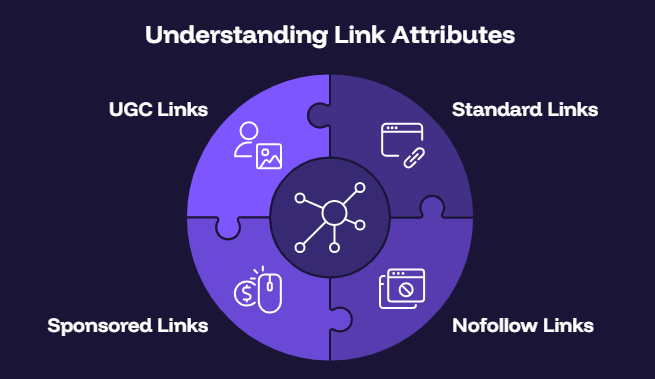
Understanding Followed, Nofollow, Sponsored, and UGC Links
Links can include a rel attribute that explains the relationship between the publisher and the linked page.
Standard or followed links
A standard link does not contain nofollow, sponsored, or ugc. Search engines can crawl and interpret it in the normal way. SEO professionals often call this a dofollow link, although dofollow is not an HTML attribute.
Nofollow links
A publisher may use rel="nofollow" when it does not want Google to associate the site with the destination or when the other available values are not appropriate. A nofollow link can still be visible, clickable, and capable of sending referral traffic.
Sponsored links
Google recommends rel="sponsored" for advertisements, sponsorships, and paid placements. Its guidance on qualifying outbound links explains when publishers should use sponsored, ugc, or nofollow attributes.
UGC links
The rel="ugc" value identifies links within user-generated content, including forum posts and comments. It helps distinguish links inserted by users from those selected by an editorial team.
Beginners should not dismiss every qualified link as worthless. A relevant sponsored, nofollow, or UGC link can still create brand exposure, referral traffic, discovery, and secondary opportunities. What it should not be treated as is guaranteed ranking credit.
What Makes a High-Quality Backlink?
No single metric can determine link quality. A useful evaluation considers the source website, the specific page, the surrounding content, the placement, and the likely audience.
1. Topical relevance
The linking website and page should have a credible relationship with the destination. A cybersecurity company will usually gain more contextual value from a link in a technology, software, compliance, or business publication than from an unrelated recipe page.
Relevance does not require an exact niche match. A broad business publication can be suitable if the article and audience genuinely connect to the subject. The test is whether an editor could explain why the link helps the reader.
2. Editorial justification
A strong link exists because it contributes to the article. It may provide evidence, define a concept, offer a tool, show an example, or help a reader take the next step.
Links that feel inserted only to influence rankings are weaker editorially and may create policy risks. Before pursuing a placement, ask what function the destination serves within the proposed content.
3. Source credibility
Review the website as a reader would. Look for clear ownership, useful original content, real editorial standards, consistent publishing quality, and a coherent subject focus.
Third-party metrics such as Domain Authority, Domain Rating, Trust Flow, Citation Flow, and estimated traffic can help filter a large prospect list. They are not Google metrics, and they should never replace manual evaluation.
4. Page quality
Evaluate the actual page, not only its domain. A link from a strong website can still appear on a thin, irrelevant, or neglected page. Conversely, a well-written specialist article may be valuable even when the overall domain is not a household name.
Check whether the page is original, indexed, readable, maintained, and relevant to the destination. Review the other outbound links to see whether they appear selective or indiscriminate.
5. Contextual placement
A link within the main body of an article generally provides more reader context than one hidden in a footer, template, author box, or long list of unrelated resources. Context explains why the link exists and what the reader should expect after clicking.
6. Natural anchor text
Anchor text is the clickable wording of a link. Good anchor text is concise, descriptive, and consistent with the destination. Google recommends writing descriptive and contextually relevant anchor text rather than forcing keywords into every link.
7. A real audience
A site with genuine readers creates possibilities beyond rankings. Look for signs of audience activity, branded visibility, newsletter distribution, social engagement, or consistent organic traffic. Traffic estimates are imperfect, but they can help distinguish a functioning publication from a site created primarily to host links.
8. Sensible outbound linking
Quality publishers link selectively. A website that publishes unrelated articles across every possible niche, uses repeated commercial anchors, or sends links to questionable destinations deserves closer scrutiny.
9. Crawlability and indexability
The linking page should be accessible to search engines and the link should use a normal <a href> element. A link hidden behind a script, blocked page, or non-indexable document may not be processed as expected.
10. Long-term editorial stability
A backlink is more useful when the page is likely to remain live, accurate, and accessible. No publisher can credibly guarantee permanent rankings or unchanging search value, but editorial stability and transparent placement terms reduce unnecessary uncertainty.
Domain Authority and Domain Rating: What Beginners Should Know
Domain Authority, commonly called DA, is a metric created by Moz. Domain Rating, commonly called DR, is an Ahrefs metric. Other tools offer their own authority and trust measurements.
These scores are estimates created by third-party platforms. Google does not use DA or DR as ranking metrics. They are useful for comparison, prospect filtering, and detecting unusual patterns, but a higher score does not automatically mean a better backlink.
For example, a high-DR website may have little topical relevance, declining traffic, or poor editorial practices. A smaller specialist publication may have a concentrated audience, strong content, and a natural reason to cite your page.
Use metrics as questions, not answers:
- Does the site’s authority score match the apparent quality of its content?
- Is its estimated traffic stable and relevant?
- Does it rank for subjects connected to your market?
- Are its strongest pages legitimate editorial resources?
- Does its backlink profile appear natural?
- Would you still want the placement if the metric were hidden?
That final question is particularly useful. If the link has no audience, relevance, or editorial purpose without the score, it may not be a strong opportunity.
Anchor Text and Its Role in SEO Link Building
Anchor text helps readers and search engines understand the destination of a link. The objective is clarity, not repetition of the same commercial keyword.
Common anchor text types
| Anchor type | Example for Backlinkrs | Appropriate use |
| Branded | Backlinkrs | Brand references and company mentions |
| Exact match | guest posting services | When it reads naturally and accurately describes the destination |
| Partial match | managed guest posting solutions | Contextual variation around a relevant topic |
| Naked URL | https://backlinkrs.com/ | Citations, profiles, or situations where the URL itself is useful |
| Generic | learn more | Occasional calls to action when surrounding context is clear |
| Page title | Guest Posting: The Complete Guide to Guest Blogging | Editorial citations to a specific resource |
A natural backlink profile usually contains variation because different writers describe the same source differently. If every acquired backlink uses an identical money keyword, the pattern may look artificial and the prose will often feel forced.
Beginners should give editors enough context to understand the preferred destination but allow room for editorial wording. Branded, partial-match, page-title, and natural descriptive anchors are often easier to integrate than repeating one exact keyword.
How to Create a Link Building Strategy Step by Step
A sustainable campaign begins before outreach. The following process turns link building from an isolated activity into a repeatable marketing system.
Step 1: Define the business objective
Decide what the campaign should accomplish. Common objectives include:
- Improving the visibility of a commercial landing page
- Supporting a new topic cluster
- Earning references to original research
- Increasing qualified referral traffic
- Building brand awareness within a specific industry
- Strengthening the authority of an underperforming page
Avoid using “get more backlinks” as the complete goal. A number without a business outcome encourages teams to pursue easy links instead of useful ones.
Step 2: Record your baseline
Before starting, document current rankings, organic clicks, referring domains, conversions, and target-page performance. Use Google Search Console, your analytics platform, and one consistent backlink tool.
The Links report in Google Search Console can show examples of external linking sites, linked pages, and linking text. It is not a complete index of every backlink, so use it as one source of evidence rather than the only record.
Step 3: Choose the pages you want to support
Not every page deserves link acquisition. Prioritize pages that are useful, relevant to business goals, technically sound, and capable of satisfying search intent.
A common beginner mistake is sending every backlink to the homepage. Build links to a sensible mix of original resources, category pages, service pages, tools, studies, and highly useful articles. Internal links can then guide authority and readers toward related commercial pages.
Step 4: Create something worth referencing
Outreach cannot permanently compensate for weak content. Build assets that give publishers a genuine reason to cite you. Examples include:
- Original research or survey findings
- Industry statistics with transparent sourcing
- Free tools, calculators, and templates
- Detailed beginner guides
- Expert commentary on a developing issue
- Visual explanations and data graphics
- Case studies with measurable outcomes
- Definitive comparison pages
- Curated resources that save readers time
Your broader content marketing strategy should identify which subjects matter to your audience and which formats are most likely to earn references. Google advises publishers to focus on helpful, reliable, people-first content, not material produced mainly to manipulate rankings.
Step 5: Find relevant websites
Build a focused prospect list instead of collecting every website that accepts submissions. Search for industry publications, associations, resource pages, complementary businesses, podcasts, newsletters, journalists, and established blogs.
Useful prospecting methods include:
- Reviewing websites that mention competing resources
- Searching for publications that cover your subject
- Identifying broken or outdated references on relevant pages
- Finding authors who regularly write about your industry
- Looking for unlinked mentions of your company or experts
- Reviewing publisher marketplaces with transparent niche and quality filters
The goal is not to find websites willing to add any link. It is to find websites for which your contribution is relevant.
Step 6: Qualify every prospect
Create a consistent review checklist. Assess topical relevance, content quality, website ownership, organic visibility, audience fit, outbound link patterns, page indexability, and editorial standards.
If you use authority or traffic thresholds, treat them as starting filters. Manually review the publication before approving it. A smaller list of well-qualified prospects usually produces better decisions than a spreadsheet filled with impressive but unexplained metrics.
Step 7: Choose the right outreach angle
Do not begin an email with the fact that you want a backlink. Begin with the value you can provide to the publication or its readers.
A strong pitch might offer:
- A specific article idea supported by expertise
- New data relevant to an existing story
- A replacement for an outdated or broken resource
- A concise expert quotation
- A useful visual or example
- A correction with reliable evidence
- A collaboration that benefits both audiences
Personalization should demonstrate relevance, not merely insert the recipient’s first name. Mention a specific content gap, audience need, or editorial connection.
Step 8: Produce publication-quality content
If the opportunity involves an article, study the publisher’s audience, tone, formatting, and editorial guidelines. The contribution should be useful even if the backlink were removed.
A thoughtful guest posting strategy focuses on subject expertise and audience value. It does not reproduce one generic article across many websites. If internal capacity is limited, professional content writing services can help turn expert knowledge into structured, publisher-ready material.
Step 9: Review the link before publication
Confirm that the destination page is correct, the anchor text reads naturally, and the surrounding paragraph genuinely supports the link. Check whether the publisher applies nofollow or sponsored attributes and whether the arrangement complies with its editorial standards and applicable search policies.
Step 10: Verify and record the result
After publication, document:
- Source domain and live URL
- Target URL
- Anchor text
- Link attribute
- Publication date
- Placement type
- Relevant site and page metrics
- Index status
- Referral traffic
- Ranking and conversion observations
Check the page periodically. Links can change, pages can be redirected, and articles can be updated or removed.
Step 11: Improve the campaign using evidence
Compare results by method, target page, topic, and publication type. Identify which placements produce qualified visitors, branded searches, relationships, or measurable visibility.
SEO outcomes take time and are influenced by content, technical health, competition, search intent, and algorithm changes. Do not attribute every ranking movement to the newest backlink. Look for patterns across a meaningful period.
Beginner-Friendly Link Building Methods
Different campaigns require different methods. The following approaches can work when they are relevant, selective, and supported by worthwhile content.
Guest posting
Guest posting involves contributing an original article to another publication. It can build exposure, demonstrate expertise, reach new readers, and create a relevant editorial reference.
Read the complete guest blogging guide before planning outreach, topics, and publisher selection. Avoid submitting generic content at scale or forcing keyword-rich anchors into every contribution. The article should fit the host publication and provide independent value.
Digital public relations
Digital PR earns coverage by providing news, data, expert analysis, or a strong story. Campaigns may involve original research, reactive commentary, trend analysis, or a useful public resource.
The advantage is that one strong idea can earn coverage from multiple relevant publications. The challenge is that editorial outcomes cannot be guaranteed and the campaign must compete for attention.
Linkable assets
A linkable asset is a resource intentionally designed to be useful enough to cite. Calculators, statistics pages, templates, studies, glossaries, and comprehensive guides are common examples.
The earlier SEO statistics for 2026 resource is an example of a format that can attract references when its figures remain accurate, dated, and connected to original sources.
Resource-page outreach
Some organizations maintain curated pages of recommended tools, guides, associations, or learning resources. If your asset genuinely improves such a page, contact the editor with a brief explanation of its relevance.
Do not pursue broad, low-quality resource pages created primarily to exchange links. The page should have a clear audience and editorial purpose.
Broken-link building
Broken-link building involves finding an unavailable external resource, creating or identifying a suitable replacement, and notifying the site owner.
Success depends on equivalence. A homepage or loosely related service page is rarely a good replacement for a detailed source that disappeared. Make the editor’s job easier by identifying the exact broken link, explaining the issue, and presenting a genuinely useful alternative.
Unlinked brand mentions
Publishers may mention your company, product, research, or team without linking to the source. A polite request can help readers verify the reference or find the resource.
This works best when the mention is specific and a link clearly improves the article. Not every casual brand reference needs a backlink.
Expert contributions
Journalists, podcasters, newsletter writers, and industry publishers regularly need informed commentary. Develop clear areas of expertise, provide concise answers, and support claims with evidence.
The primary objective should be to contribute something useful. Links and mentions are possible outcomes of credibility, not something every editor will provide.
Niche insertions
A niche insertion, also called a link insertion or niche edit, places a relevant link within an existing article. The destination should add value to the established content, and the surrounding copy may need a careful update so the reference reads naturally.
Quality control is essential. Niche insert services should evaluate the existing page, its relevance, outbound-link quality, indexability, and editorial fit rather than inserting a link wherever space is available.
Strategic partnerships
Suppliers, associations, integration partners, clients, and complementary businesses may have legitimate reasons to reference one another. Examples include joint research, verified partner directories, integration documentation, event pages, and co-created educational resources.
Avoid excessive reciprocal-link arrangements created solely for rankings. The relationship and reader benefit should exist independently of SEO.
A Practical 90-Day Link Building SEO Plan
Beginners do not need dozens of tactics at once. A focused three-month plan is easier to execute and evaluate.
Days 1 to 30: Build the foundation
- Select one business objective and two or three target pages.
- Record baseline rankings, clicks, referral traffic, and conversions.
- Audit existing backlinks and internal links.
- Improve the target pages so they fully satisfy intent.
- Create one strong linkable asset.
- Define prospect qualification rules.
- Build an initial list of 40 to 60 relevant websites.
Days 31 to 60: Begin promotion
- Segment prospects by outreach angle.
- Send small, personalized outreach batches.
- Pitch several carefully chosen guest-post topics.
- Find unlinked brand mentions and suitable resource pages.
- Offer original data or expert commentary where relevant.
- Track replies, objections, publication requirements, and results.
Days 61 to 90: Publish and refine
- Complete approved contributions to a high editorial standard.
- Verify every live placement and record its details.
- Monitor referral traffic, rankings, and conversions.
- Identify which pitches and content formats produced the strongest response.
- Expand the most effective method and discontinue low-quality activity.
- Strengthen internal links from supported resources to related pages.
This approach is intentionally modest. Consistency, qualification, and learning are more valuable than an ambitious campaign that becomes unmanageable after two weeks.
How Much Does Link Building Cost?
There is no universal price because campaigns differ in research, content production, publisher requirements, niche difficulty, editorial review, and account management.
Common cost components include:
- Strategy and competitor research
- Prospect discovery and qualification
- Outreach and relationship management
- Original content or data production
- Design, tools, or development for linkable assets
- Editorial coordination
- Publisher or sponsorship charges where applicable
- Monitoring and reporting
Restricted or commercially sensitive industries may face higher publishing costs because fewer suitable websites accept those subjects and editorial review may be more demanding.
Compare cost with expected relevance and business value, not only the number of links promised. Extremely cheap bulk packages often remove the human work required for research, quality control, and editorial fit.
For campaigns with defined deliverables, link building packages can make budgeting easier. Review the included publisher standards, content scope, link attributes, turnaround, reporting, and replacement terms before purchasing.
How Long Does Link Building Take to Work?
There is no reliable fixed timeline. Search engines must discover or revisit the linking page, process its content, and reassess the wider search environment. The target page must also be competitive in relevance, quality, technical health, and user satisfaction.
A new backlink may be discovered quickly without producing an immediate ranking change. Several strong placements may support gradual growth, while a weak page may remain underperforming regardless of how many links point to it.
Measure progress at several levels:
- Execution: qualified prospects, replies, approved topics, and published placements.
- Visibility: indexation, impressions, keyword coverage, and referring domains.
- Engagement: referral visits, time on page, assisted conversions, and branded search activity.
- Business impact: leads, revenue, sign-ups, and acquisition cost.
Avoid guarantees such as first-page rankings within a particular number of days. SEO is probabilistic, competitive, and affected by many factors outside a link builder’s control.
How to Measure Link Building Results
The number of acquired backlinks is an activity metric, not a complete performance report.
Referring domains
Track how many distinct websites link to you. Ten links from ten relevant publications usually create a broader reference footprint than ten links from one domain, although quality still matters more than the count.
Target-page performance
Monitor impressions, clicks, average position, conversions, and non-branded keyword visibility for the page being supported. Compare results with a baseline and account for other changes made during the campaign.
Referral traffic
Review how many visitors arrive through each placement and what they do next. A lower-authority specialist site may send more qualified users than a high-metric general publication.
Link quality distribution
Group placements by relevance, editorial context, link attribute, page quality, and audience fit. This creates a more useful view than reporting one average authority score.
Brand outcomes
Track branded searches, direct traffic, media mentions, partnership enquiries, and repeat citations. Link acquisition can create value that last-click attribution fails to show.
Campaign efficiency
Measure the time and cost required to research, contact, produce, publish, and monitor each successful placement. This helps determine which methods deserve further investment.
Common Link Building Mistakes
Prioritizing quantity over relevance
Large backlink counts can look impressive in a report while contributing little business value. One relevant article read by the right audience can outperform dozens of indiscriminate placements.
Trusting authority metrics blindly
DA, DR, TF, and CF are useful diagnostic measurements, not proof of editorial quality or future ranking impact. Review the actual website and page.
Repeating exact-match anchor text
Forcing the same keyword into every backlink produces awkward writing and an unnatural pattern. Use branded, descriptive, page-title, URL, and partial-match variations where appropriate.
Sending every backlink to the homepage
Deep links to useful resources, category pages, and relevant service pages can create stronger contextual connections. The destination should match the reason for the link.
Publishing thin guest posts
A weak article created mainly to carry a link provides little value to the host audience. It also reflects poorly on the brand being promoted.
Ignoring the publisher’s outbound links
Review what else the website links to. Repeated links to unrelated, low-quality, or risky destinations may indicate weak editorial control.
Using automated comments, directories, or forum profiles
Automation can create large numbers of links quickly, but many are ignored, removed, or associated with spam. Google’s link spam policies specifically identify automated link creation, low-quality directory links, optimized forum links, and excessive link exchanges as problematic examples.
Assuming every paid link can pass ranking credit
Payment, sponsorship, and advertising relationships require careful disclosure and link qualification. Google states that paid links should use rel="sponsored" or rel="nofollow" when appropriate. Publishers control their sites and should apply attributes according to their policies and applicable search guidelines.
Failing to track live placements
Without a record of source URLs, target pages, anchors, attributes, dates, and outcomes, teams cannot monitor changes or learn which placements work.
Expecting links to repair weak fundamentals
Backlinks cannot permanently solve poor search intent alignment, thin content, technical barriers, weak conversion paths, or an incoherent site structure. Link building works best when the underlying page already deserves to rank and convert.
Link Building Practices to Avoid
Google defines link spam as creating links to or from a site primarily to manipulate search rankings. Examples in its current policies include buying or selling links for ranking purposes, excessive exchanges, automated link creation, low-quality directories, widely distributed footer links, and advertorial links that pass ranking credit.
Avoid:
- Automated backlink software
- Private networks created primarily to pass links
- Bulk comment and forum-profile links
- Unrelated guest posts created only for anchor placement
- Low-quality directories with no real audience
- Sitewide footer or template links arranged for rankings
- Hidden links
- Excessive reciprocal-link schemes
- Repeated keyword-rich anchors across many sites
- Claims of guaranteed rankings or permanent SEO value
Legitimate marketing, sponsorship, and publisher relationships can exist, but the links should be transparently handled and qualified where required. The distinction is purpose, editorial value, disclosure, and implementation.
How Backlinkrs Supports a More Structured Link Building Process
Managing prospect research, publisher communication, content production, and order tracking can become difficult as a campaign grows. Backlinkrs brings these activities into a more structured workflow for businesses, agencies, and marketers.
Through the Backlinkrs guest post marketplace, users can compare publisher opportunities using information such as niche, authority metrics, estimated traffic, language, link type, accepted subjects, and publishing requirements. This makes it easier to narrow a large market into websites that fit a specific campaign rather than relying on unverified lists.
Backlinkrs provides guest posting services, niche insert services, and managed link building packages. Professional article writing is included with every paid guest post order at no additional cost. Content is prepared to be original, SEO-optimized, publisher-ready, and aligned with the selected website’s editorial requirements.
The platform is designed around transparent publisher information, manual quality review, natural anchor integration, clear order updates, and editorial coordination. Backlinkrs does not promise guaranteed rankings, and campaigns should always be evaluated for relevance, user value, publisher policy, and applicable search-engine guidance.
A Beginner’s Link Building Checklist
Before approving any campaign or placement, ask:
- Is the target page genuinely useful and ready to receive visitors?
- Is the linking website relevant to the topic or audience?
- Does the specific article provide meaningful editorial context?
- Would the link help a human reader?
- Is the anchor text descriptive and natural?
- Has the website been manually reviewed beyond its DA or DR?
- Is the linking page crawlable and indexable?
- Are sponsorships or commercial relationships disclosed and qualified appropriately?
- Does the campaign avoid repetitive patterns and bulk automation?
- Are the source URL, target URL, anchor, attribute, and publication date recorded?
- Are referral traffic and conversions being measured alongside rankings?
- Would the placement still have brand or audience value without an assumed ranking benefit?
If several answers are no, reconsider the opportunity.
Final Thoughts
Link building is most effective when it connects valuable content with relevant audiences. Search engines may use links to discover pages and interpret relationships, but the strongest campaigns are not built around exploiting a metric. They are built around usefulness, credibility, editorial judgment, and distribution.
For a beginner, the essential process is to choose a meaningful objective, improve the destination page, create something worth citing, qualify relevant publishers, communicate a clear value proposition, and measure more than backlink totals.
A sustainable link building SEO strategy does not ask, “How can I create the most links?” It asks, “Where would a reference to this page genuinely help the reader?” That question leads to better content, better placements, and better long-term decisions.
Frequently Asked Questions About Link Building
Link building is the process of earning or acquiring hyperlinks from other websites to your pages. These links can help search engines discover content, understand topical relationships, and evaluate usefulness alongside many other signals.
Yes. Google’s current ranking systems documentation confirms that link analysis systems and PageRank remain part of how Google understands and ranks pages. However, links are only one part of SEO and quality matters more than raw volume.
There is no universal number. Requirements vary by query, competition, content quality, search intent, website history, and the relevance of existing links. Compare the quality and context of competing pages rather than chasing a fixed count.
A backlink is an individual incoming link. Link building is the strategy and work used to earn, acquire, manage, and evaluate those links.
They can be. Nofollow links may generate referral traffic, brand exposure, discovery, and future citations. They should not be treated as guaranteed ranking credit.
Start by creating one strong resource, identifying a small group of relevant publications, and conducting personalized outreach. Guest contributions, unlinked mentions, resource-page outreach, and expert commentary are manageable starting methods when used selectively.
Guest posting can be valuable when the article serves the host audience, demonstrates real expertise, and follows editorial and search-engine policies. Large-scale, low-quality guest posting built mainly around keyword-rich links creates greater risk.
Use both as supporting indicators, but prioritize topical relevance, page quality, editorial standards, real audience value, and outbound-link practices. Neither DA nor estimated traffic can independently prove that a backlink is worthwhile.
Prospecting and publication may take days or weeks, while search effects may develop over a longer and unpredictable period. Results depend on the link, target page, competition, crawling, content quality, and other SEO activity.
Manipulative link schemes can create risk. Automated links, excessive exchanges, low-quality directories, hidden links, and paid links that improperly pass ranking credit are among the practices addressed in Google’s spam policies.
Sometimes. Unlinked mention reclamation, broken-link replacement, expert commentary, partnerships, and carefully selected niche insertions can use existing assets. Strong original content still makes outreach easier and gives publishers more reasons to reference your site.
Monitor the linking page, referral traffic, target-page impressions, clicks, rankings, conversions, branded searches, and future citations. Evaluate trends over time rather than expecting one link to produce an isolated ranking jump.