
Guest Posting vs. Blogger Outreach: What’s the Difference?
Building backlinks is an important part of improving a website’s search visibility, but not every link-building strategy works in the same way. Two terms that often come up in this process are guest posting and blogger outreach. While they are closely related, they serve different purposes and involve different approaches.
If you are exploring ways to earn backlinks, improve brand visibility, or connect with relevant websites, understanding the difference between these two strategies can help you make better decisions.
At Backlinkrs, you can discover websites, evaluate opportunities, compare publishers, and explore guest posting options for different SEO requirements.
So, what exactly separates guest posting from blogger outreach? Let’s take a closer look.
What Is Guest Posting?
Guest posting is a content marketing and link-building strategy in which you contribute an article to another website or blog within your industry or a relevant niche.
The article is published under your name, your brand’s name, or an agreed author profile. Depending on the publisher’s editorial guidelines, you may also be allowed to include contextual links pointing to relevant pages on your website.
For example, suppose you operate a digital marketing website and want to reach a wider audience. You could contribute an article about SEO strategies to a marketing blog. Within the article, you might naturally reference one of your relevant resources.
The primary purpose of guest posting is to provide useful content to another website’s audience while creating opportunities for brand exposure, referral traffic, and relevant backlinks.
If you are new to this approach, our complete guide to guest blogging explains the process, benefits, and practical considerations in greater detail.
How Does Guest Posting Work?
The process generally involves the following steps:
- Find relevant websites: Identify blogs and publishers that cover topics related to your industry.
- Evaluate publishing opportunities: Review website relevance, content quality, audience, organic visibility, and publishing guidelines.
- Prepare a suitable topic: Develop an article idea that fits the publisher’s audience and editorial direction.
- Write the content: Create an original, informative article that meets the website’s requirements.
- Submit and publish: Send the article for review and work with the publisher to get it published.
- Review the placement: Check the published article, links, and overall content presentation.
If you are unsure where to begin, read our guide on how to find websites that accept guest posts. It covers practical ways to identify potential publishers.
You can also use search queries for finding guest posting opportunities to discover websites through search engines.
What Is Blogger Outreach?
Blogger outreach is the process of contacting bloggers, website owners, editors, and publishers to establish professional relationships and explore opportunities for collaboration.
Unlike guest posting, blogger outreach is not limited to publishing articles. It is a broader approach that can support several marketing and link-building activities.
For example, a business might contact a blogger to request a product review, suggest a resource for an existing article, propose a content collaboration, or contribute a guest article.
The objective is to connect with relevant publishers and find mutually beneficial opportunities.
Blogger outreach also fits into a broader content marketing strategy, particularly when businesses want to reach audiences beyond their own websites.
How Does Blogger Outreach Work?
Blogger outreach typically follows a relationship-driven process:
- Identify relevant bloggers: Research websites, independent publishers, and industry-specific blogs.
- Find contact information: Locate appropriate editorial or business contact details.
- Understand the website: Review its content, audience, publishing standards, and existing collaborations.
- Prepare personalized communication: Write an outreach message that explains the purpose of contacting the publisher.
- Discuss opportunities: Explore possible collaborations, content contributions, mentions, or other arrangements.
- Build relationships: Maintain professional communication and develop opportunities for future collaboration.
Successful blogger outreach depends on relevance, personalization, and the value you bring to the publisher. Sending identical emails to hundreds of websites without understanding their content rarely produces meaningful results.
Guest Posting vs. Blogger Outreach: Key Differences
Although both strategies can support SEO and content marketing, they differ in their approach, execution, and intended outcomes.
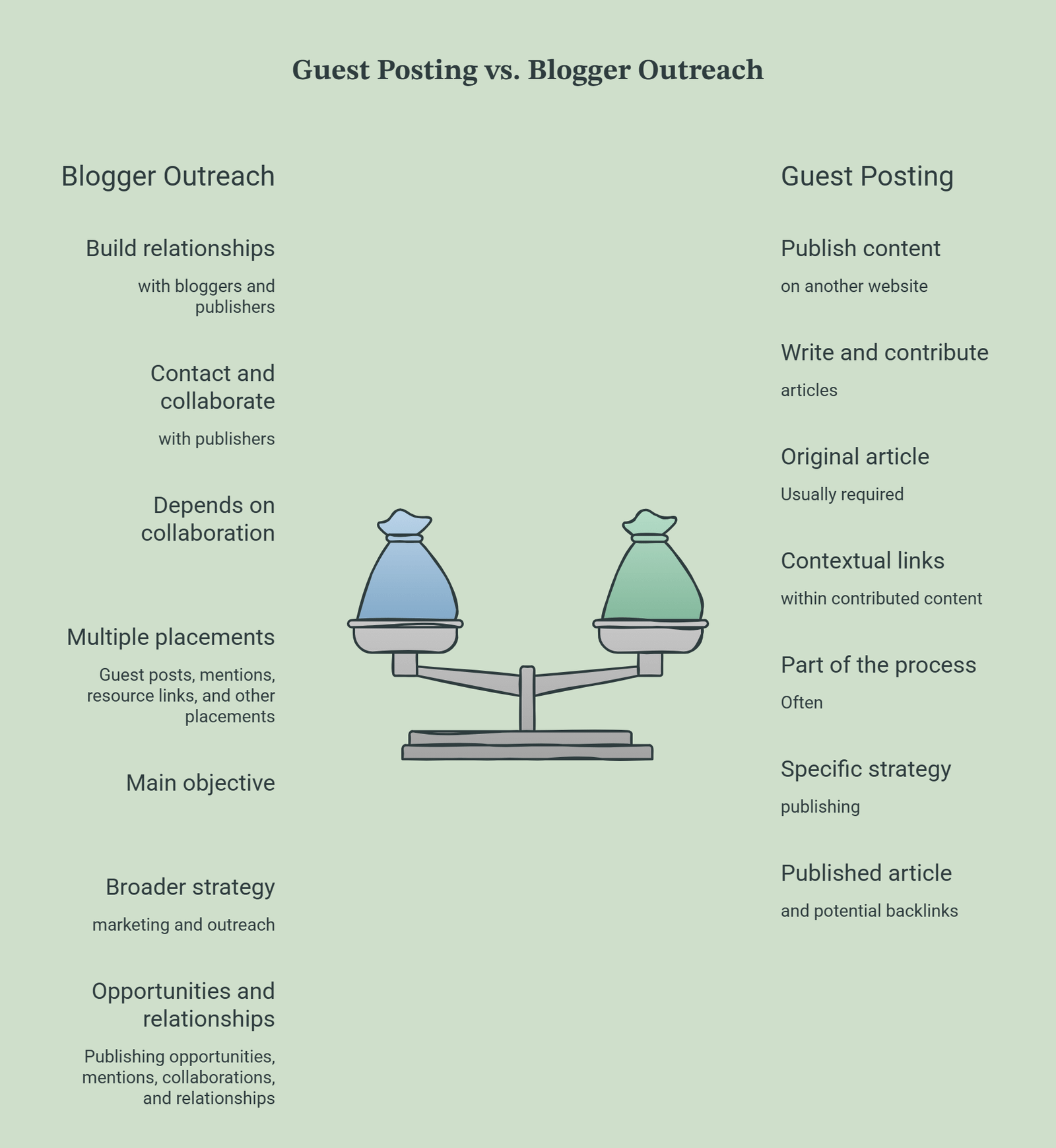
| Comparison | Guest Posting | Blogger Outreach |
|---|---|---|
| Primary purpose | Publish content on another website | Build relationships with bloggers and publishers |
| Main activity | Writing and contributing articles | Contacting and collaborating with publishers |
| Content requirement | Usually requires an original article | Depends on the collaboration |
| Backlink opportunities | Contextual links within contributed content | Guest posts, mentions, resource links, and other placements |
| Relationship building | Often part of the process | One of the main objectives |
| Scope | A specific publishing strategy | A broader marketing and outreach strategy |
| Typical outcome | Published article and potential backlinks | Publishing opportunities, mentions, collaborations, and relationships |
The simplest way to understand the difference is that guest posting focuses on contributing content, whereas blogger outreach focuses on establishing connections with publishers to create opportunities.
To understand how both strategies contribute to a larger SEO campaign, it helps to explore link building for SEO and the fundamentals of search engine optimization.
Is Guest Posting a Part of Blogger Outreach?
Yes. Guest posting is one of the most common activities carried out through blogger outreach.
Think of blogger outreach as the broader process and guest posting as one of the possible outcomes.
For example, when you contact a website editor and propose writing an article for their blog, you are performing blogger outreach. When that article gets approved and published, the activity becomes guest posting.
However, not every blogger outreach campaign results in a guest post.
A publisher might agree to mention your brand in an existing article, review your product, link to one of your resources, or collaborate on another form of content.
This distinction is important because it helps businesses understand that outreach can create several opportunities beyond traditional guest article placements.
Different Types of Blogger Outreach Opportunities
Blogger outreach can support several activities depending on your marketing objectives and the type of websites you want to connect with.
Some common approaches include:
Guest Post Outreach
This involves contacting website owners or editors to propose original articles for their websites. It is one of the most widely used outreach methods for earning contextual backlinks and expanding content reach.
Niche Edits and Contextual Link Placements
Instead of creating an entirely new article, you approach a publisher about adding a relevant link to an existing piece of content.
These placements are commonly called niche edits or contextual backlinks. The existing article should be relevant to the linked resource, and the addition should make sense for readers.
Businesses interested in this approach can explore the Backlinkrs Niche Edit Service.
Product Reviews and Brand Mentions
Businesses can approach bloggers who cover products or services within their industry. These collaborations may involve product reviews, brand mentions, or editorial coverage.
Such opportunities can help introduce a business to an established audience.
Resource Link Outreach
Resource link outreach involves identifying useful articles, resource pages, and industry guides where your content could provide additional value.
You contact the publisher with a relevant resource that genuinely complements their existing content.
Content Collaboration
Businesses and bloggers can also collaborate on interviews, expert contributions, industry roundups, and other content formats.
These collaborations can help both parties reach new audiences and establish industry connections.
Which Strategy Is Better for SEO?
Neither strategy is automatically better than the other. The right choice depends on your goals, available resources, and the type of opportunities you want to pursue.
Guest posting is a practical option when:
- You want to publish original content on relevant websites.
- You are looking for contextual backlink opportunities.
- You want to introduce your brand to a new audience.
- You have useful industry knowledge that can be turned into informative articles.
- You want a repeatable content contribution strategy.
Blogger outreach is useful when:
- You want to establish relationships with publishers.
- You are exploring different backlink acquisition methods.
- You want to secure brand mentions or editorial coverage.
- You are interested in product reviews and content collaborations.
- You want to develop long-term publishing opportunities.
For many businesses, combining both approaches makes more sense than treating them as competing strategies.
Blogger outreach helps identify and develop opportunities, while guest posting provides a structured way to turn some of those opportunities into published content.
These strategies also need to be considered within the changing search landscape. Our SEO statistics for 2026 offer additional context on the broader SEO environment.
How to Find the Right Websites for Guest Posting and Blogger Outreach
Finding the right publishers is often more important than simply increasing the number of websites you contact.
A backlink from a relevant, well-maintained website can be more valuable than a placement on a website that has little connection to your industry.
Here are some factors to consider when evaluating potential publishers.
Check Niche Relevance
Start by identifying websites that publish content related to your business, industry, or target audience.
A website’s topical relevance helps establish whether a potential placement makes sense within its existing content.
Review Website Authority Metrics
Metrics such as Domain Authority (DA), Page Authority (PA), and Domain Rating (DR) can provide additional information when comparing websites.
However, these metrics should not be treated as direct measures of Google rankings or guaranteed indicators of backlink quality.
Consider them alongside website relevance, content quality, organic visibility, and overall publishing standards.
Examine Organic Traffic
Look beyond authority scores and assess whether a website receives genuine organic traffic.
Review its indexed pages, ranking keywords, traffic trends, and the quality of its existing articles.
A website with relevant readership can offer opportunities for referral traffic and brand exposure in addition to SEO benefits.
Review Existing Content
Take time to read a few articles before approaching a publisher.
Look at content depth, editorial consistency, outbound links, article quality, and how frequently the website publishes new material.
Compare Publishing Opportunities
Rather than contacting websites randomly, organize potential publishers based on niche, metrics, pricing, and publishing requirements.
You can explore guest posting sites in the USA and guest posting sites in Indonesia to discover publishing opportunities in different markets.
For more specialized campaigns, you can also explore casino and gambling guest posting sites.
Can You Use Both Strategies Together?
Absolutely. In fact, using guest posting and blogger outreach together can create a more flexible link-building approach.
Consider a business that wants to improve its online visibility within the technology industry.
It could begin by researching relevant technology blogs and identifying potential publishers. Through blogger outreach, the business could contact website owners, discuss collaboration opportunities, and propose useful article topics.
Some publishers might accept guest contributions, while others may offer opportunities for resource mentions or contextual placements.
This allows the business to explore multiple ways of earning relevant links rather than relying on a single method.
A balanced approach could include:
- Guest posting for original content contributions.
- Blogger outreach for building publisher relationships.
- Niche edits for relevant existing content placements.
- Content collaborations for additional brand exposure.
The important thing is to prioritize relevance and editorial value instead of focusing entirely on backlink quantity.
How Backlinkrs Can Help You Find Guest Posting Opportunities
Finding publishers, checking their websites, comparing metrics, and managing individual outreach conversations can take considerable time.
Backlinkrs makes the publisher discovery and guest posting process more straightforward by bringing publishing opportunities together in one place.
Whether you are an SEO professional, digital marketing agency, business owner, or content marketer, you can explore websites across different niches and evaluate opportunities based on your requirements.
Here are a few ways to get started:
- Guest Posting Marketplace: Discover websites and compare available publishing opportunities.
- Guest Posting Packages: Explore bundled guest posting options for different requirements.
- Guest Posting Service: Find a more streamlined approach to getting guest articles published.
- Niche Edit Service: Explore contextual backlink placement opportunities within existing content.
- Professional Content Writing Service: Get professionally written content for your publishing requirements.
Professional content writing is included with every guest post order, helping simplify the process of preparing articles for publication.
Final Thoughts
Guest posting and blogger outreach are closely connected, but they are not interchangeable terms.
Guest posting is a content contribution strategy focused on publishing articles on other websites. Blogger outreach is a broader process of connecting with publishers and exploring opportunities such as guest articles, contextual links, brand mentions, and content collaborations.
For businesses looking to improve their online presence, understanding how these strategies work together can make link-building efforts more organized and effective.
Rather than choosing one over the other, consider how both approaches can support your broader SEO and content marketing objectives. Focus on relevant publishers, useful content, and genuine value for the audience. Those are the foundations of a sustainable approach to building online visibility.