
How to Find Websites That Accept Guest Posts
Finding websites that accept guest posts is easy if all you need is a list of domains. Finding publications where your expertise belongs requires more thought.
A website can welcome contributors and still be a poor match for your business. Another might have no submission page, yet consider an original article that answers a question its readers care about.
The real task is to identify the overlap between three things: the audience you want to reach, the subjects you understand, and the publications willing to publish outside expertise.
This guide explains how to find guest posting opportunities, verify whether they are active, assess their quality, and approach editors with a reason to say yes.
How Do You Find Websites That Accept Guest Posts?
Search for your niche alongside phrases such as “write for us,” “contributor guidelines,” and “submit an article.” Then investigate competitor articles, established guest authors, industry publications, and publisher marketplaces. Read each website’s recent content and submission rules before adding it to your outreach list. Treat search results as leads, not confirmed opportunities.
Start With the Audience You Want to Reach
Before searching for websites, decide whose attention would make a placement worthwhile.
For an SEO business, that might include agency owners, marketing managers, ecommerce founders, or content strategists. These groups share some interests, but they do not necessarily read the same publications.
An agency owner might value an article about managing publisher relationships. An ecommerce founder might prefer an explanation of how to evaluate content opportunities within a limited budget.
Define four things before you begin:
- Audience: Who should read your article?
- Subject: What can you explain with depth and credibility?
- Purpose: Are you seeking qualified visitors, industry recognition, editorial relationships, or broader brand awareness?
- Destination: Which page on your website would genuinely help an interested reader?
This connects prospecting to your wider content marketing strategy. Your search becomes more precise when you know what the article is meant to accomplish.
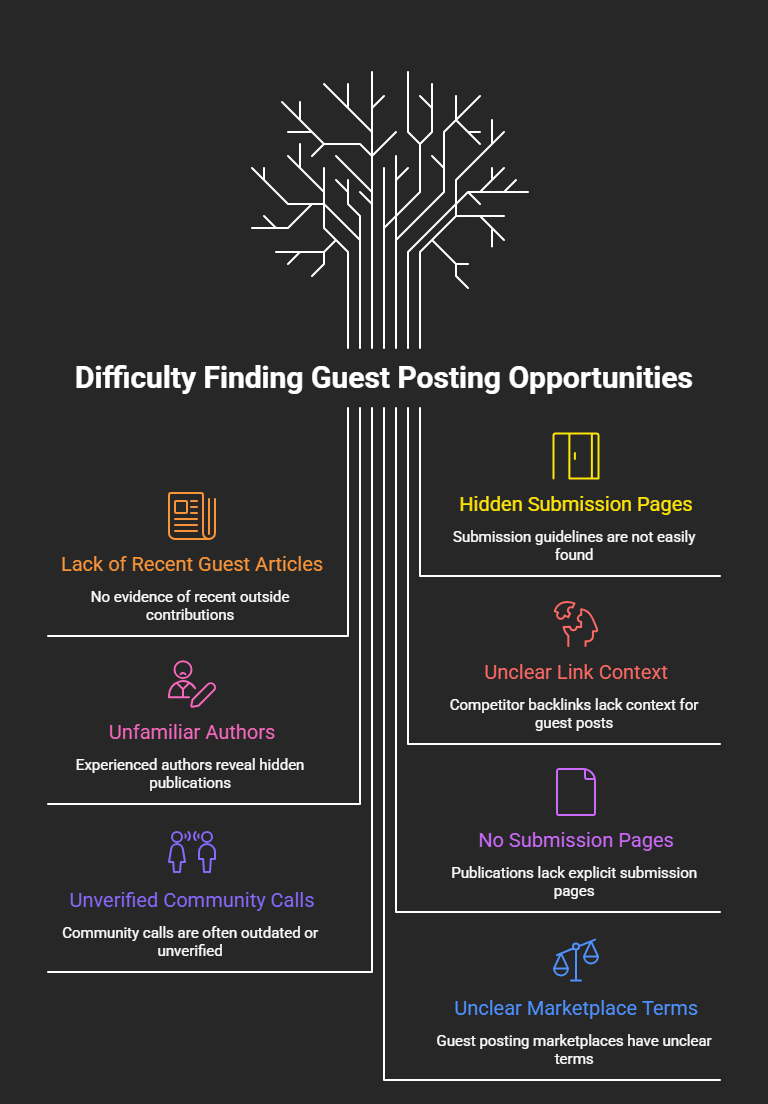
1. Use Search Queries That Reveal Contributor Pages
Search engines are a practical starting point because many publishers make their submission requirements publicly available.
Combine a relevant subject with a phrase that indicates outside contributions.
| Search query | What it can help you discover |
|---|---|
"SEO" "write for us" | SEO websites advertising contributor opportunities |
"content marketing" "contributor guidelines" | Publications with documented submission requirements |
"digital marketing" "submit an article" | Websites offering an article submission route |
"ecommerce" "guest post" | Guest articles and possible contribution opportunities |
"SaaS" "become a contributor" | Publications recruiting outside writers |
"marketing" "editorial guidelines" | Editorial standards that may explain contribution policies |
"link building" "guest author" | Published articles by outside contributors |
Quotation marks help focus a search on specific phrases, although results still require inspection. A page mentioning guest posts might be an old announcement, a discussion of guest blogging, or a directory rather than an active submission page.
Search Beyond Your Exact Niche
Relevant audiences often exist in adjacent industries.
For Backlinkrs, useful subjects to explore include publishing, digital PR, agency operations, ecommerce marketing, and content strategy. A publishing website could be suitable for an article about editorial standards, while an agency publication could suit a guide to evaluating publisher opportunities.
The connection should be clear to the reader. If explaining why your article belongs requires a strained argument, move on.
Search Within a Specific Website
When you discover an interesting publication, investigate its own pages:
site:example.com "contributor"
site:example.com "submission guidelines"
site:example.com "guest author"
site:example.com "pitch"
Replace example.com with the publisher’s domain. These searches can uncover contribution information that is difficult to find through the navigation menu.
2. Look for Published Guest Articles
A submission page shows stated policy. A recent guest article shows that outside contributions have actually been published.
Search for phrases such as:
"your niche" "guest contributor"
"your niche" "contributed by"
"your niche" "guest author"
Open the results and inspect the article, author biography, and publication date. Ask whether the writer appears to be an outside specialist, a staff member, or a sponsored contributor.
Recent outside contributions are useful evidence, but they do not prove that the publisher accepts unsolicited pitches. Some publications commission contributors directly or work only with invited experts.
Record what you know: “recent outside author identified” is more accurate than “accepts guest posts” when you have not confirmed the submission policy.
3. Investigate Competitor Backlinks With Context
Competitor backlink research can reveal publications you might otherwise miss. The important part is understanding why each link exists.
If you have access to a backlink analysis tool, examine relevant competitors’ referring pages. Look for contributed articles, expert columns, author biographies, and industry publications.
A referring domain alone tells you very little. Open the exact page and classify the placement.
| Link type | How to interpret it |
|---|---|
| Contributed article | Evidence of outside authorship, subject to current editorial rules |
| Editorial mention | Evidence of topical interest, but not necessarily a guest posting opportunity |
| Interview or expert quote | A possible relationship or expert contribution opportunity |
| Business directory profile | A listing opportunity rather than an article placement |
| Press release | A distribution placement with different editorial expectations |
| Automated website report | Usually unhelpful for identifying guest post publishers |
For example, a competitor appearing in an article about agency workflows suggests a publication worth researching. A competitor appearing in an automatically generated domain report does not.
Our beginner’s guide to link building for SEO provides broader context for understanding how different linking opportunities fit into a campaign.
4. Follow Experienced Guest Authors
Publications are only one route into a niche. People can reveal another.
Identify specialists who regularly contribute useful articles in your industry. Search their names alongside relevant subjects, then review their author pages and portfolios.
For example:
"Author Name" "content marketing"
"Author Name" "guest post"
"Author Name" "contributor"
You may discover specialist publications that never advertise themselves as guest posting websites.
Study what the author contributes. Do they bring original data, practical experience, detailed tutorials, or a distinctive argument? Their work can help you understand the publication’s editorial expectations.
A useful lesson here is that contributors earn access through what they know and how clearly they communicate it. Finding the publisher is only the beginning.
5. Research Industry Publications Without Submission Pages
Restricting your search to “write for us” pages leaves some relevant publications outside your view.
Search for trade magazines, professional association blogs, specialist newsletters, and industry resource hubs. Then inspect their editorial structure.
Look for:
- Articles written by professionals from outside organizations.
- An identifiable editor or editorial contact.
- Expert commentary, opinion columns, or practical case studies.
- Topics where your experience could add something specific.
A publication with these features may be worth a concise inquiry. Ask whether it considers outside contributions before writing a complete article, unless its published guidelines request a full draft.
Respect explicit restrictions. If a website says it does not accept guest submissions, remove it from your list.
6. Use Communities to Discover Editorial Calls
Professional communities can help you discover calls for contributors, themed issues, expert commentary, and publications your audience already reads.
Search professional networks and relevant communities for phrases such as “looking for contributors,” “accepting pitches,” and “call for articles,” paired with your industry.
Check the date and trace each opportunity back to the publisher’s official website or editorial account. An old announcement or an intermediary’s claim does not establish that submissions are currently open.
Also distinguish independent publications from platforms where anyone can create an account and publish. Self-publishing may support distribution, but it does not involve the same editorial selection as an accepted guest article.
For a wider discussion of publishing useful material across channels, read what content marketing means.
7. Explore Guest Posting Marketplaces
A marketplace can reduce the time spent discovering publishers and comparing basic placement information.
The Backlinkrs guest posting marketplace provides publisher listings with filters for factors such as niche, language, traffic, price, and SEO metrics.
Use these filters to narrow your research, then examine the publisher itself. Read recent articles, consider the audience, and confirm the current placement terms.
Keep the commercial arrangement clear. An unpaid editorial contribution and a paid publisher placement involve different expectations. For paid placements, confirm sponsorship disclosure and link qualification rather than assuming that purchasing publication guarantees a ranking benefit.
How to Evaluate a Guest Posting Website
A website’s willingness to publish your article should not be the deciding factor. Assess whether the placement makes sense for your audience and reputation.
Audience and Topical Relevance
Read the publication’s main categories and several recent articles. Could its readers plausibly be interested in your expertise or services?
A smaller specialist publication may offer a more suitable audience than a broad website with impressive headline metrics. Relevance gives your article a reason to exist there.
Editorial Quality
Look for clear arguments, accurate explanations, useful examples, identifiable authors, and consistent subject coverage.
Be cautious when unrelated industries appear together without an editorial purpose, articles repeat generic claims, or commercial links interrupt otherwise thin content.
These observations are signals for further investigation. They are not a complete verdict on their own.
Activity and Evidence of Discoverability
Check whether the website publishes and maintains content. Where appropriate, use SEO tools to examine estimated traffic, ranking topics, and longer-term trends.
Treat estimates as directional evidence. They may miss small audiences, and different tools can report different figures.
Inspect the pages behind the numbers. Traffic to unrelated topics may have little value for your proposed article. A search result showing that some pages are indexed also cannot guarantee that your future contribution will be indexed or attract readers.
Authority Metrics in Context
Third-party authority scores can help you compare prospects, but they should not replace editorial judgment. They are proprietary measurements, not promises about the outcome of a placement.
Use them alongside relevance, content quality, audience fit, and the publisher’s actual practices. Avoid choosing a website solely because it clears an arbitrary numerical threshold.
Readers who are still building this foundation can start with our beginner’s guide to SEO. Our SEO statistics for 2026 can also provide broader industry context, with attention to the date and source behind individual figures.
Link and Sponsorship Policies
Confirm whether links are allowed in the article body, author biography, or both. Ask about editorial review, anchor text restrictions, disclosure requirements, and the attributes applied to links.
Google identifies links created primarily to manipulate rankings as link spam. Its guidance calls for paid links to be qualified with rel="sponsored"; nofollow is also acceptable for this purpose.
A useful article can still offer audience exposure and referral opportunities when its links are qualified. Evaluate the placement on those merits rather than treating an unqualified link as the only measure of value.
Read the Guidelines Before Choosing Your Topic
Submission guidelines explain what the publication needs and how it expects you to work.
Check the accepted topics, required format, originality rules, word count, author credentials, image requirements, link policy, and submission process. Also confirm whether there is a fee and whether the publisher wants a pitch or a complete draft.
Then compare your idea with the website’s existing coverage. If it has already published several introductory articles about backlinks, another general definition may offer little value.
A more specific contribution could examine how to assess topical relevance, document publisher research, or recognize weak placement opportunities.
Our complete guide to guest blogging explores the broader process from planning to publication.
Build a Prospect List You Can Actually Use
Keep a working record of the evidence behind each opportunity.
| Field | What to record |
|---|---|
| Website | Publisher name and domain |
| Audience and niche | Who it serves and what it covers |
| Contribution evidence | Guidelines page, recent guest article, or editor confirmation |
| Last checked | When you verified the information |
| Submission route | Official form or editorial contact |
| Proposed topic | Your idea and why it fits |
| Placement terms | Fees, disclosure, links, and editorial restrictions |
| Priority | High, medium, or low, with a brief reason |
| Status | Researching, pitched, accepted, declined, or published |
Separate confirmed opportunities from publishers that might consider an inquiry. This prevents an appealing prospect from quietly becoming an unsupported assumption.
Prioritize relevance, evidence of outside contributions, and your ability to provide a strong article. A long list has limited value if every entry requires the same research again.
Pitch an Idea That Solves an Editorial Problem
An editor needs to understand what the article will contribute and why you are qualified to write it.
Avoid opening with a request for a backlink. Lead with the reader’s question and your proposed answer.
A concise pitch could look like this:
Subject: Article idea: Evaluating publisher relevance before guest posting
Hello,
I read your article on planning an SEO content campaign and noticed an opportunity to explore how marketers assess a publisher before proposing a guest article.
I would like to contribute a practical guide covering audience fit, recent editorial activity, link policies, and a simple research checklist.
I work in content management and publisher research, and I can include examples to make the process easier to apply.
Would this topic suit your editorial calendar?
Regards,
Neal Brown
Content Manager, Backlinkrs
Adapt the opening to something you have actually read. Personalization works when it demonstrates understanding, rather than simply inserting the website’s name into a template.
If there is no stated response window, one polite follow-up after roughly a week or two is a reasonable working approach. Avoid repeated messages after a decline or continued silence.
Use AI for Organization, Then Verify the Evidence
AI can help generate search variations, organize research notes, compare supplied guidelines, and develop article angles.
However, an AI-generated publisher list should be treated as unverified. A suggested website may be irrelevant, its submission page may be outdated, or the supposed opportunity may not exist.
Check the publisher’s own pages and record the evidence. The value of automation is the time it saves around the research, not permission to skip the research itself.
Our article on what AI backlinks are provides related background for readers exploring AI in link-building workflows.
Common Mistakes That Weaken Guest Posting Research
Trusting old lists without checking them. Publisher policies change. Revisit the original guidelines and recent content before contacting anyone.
Treating every competitor backlink as a guest post. A directory profile, press release, and contributed article represent different opportunities.
Choosing websites solely by metrics. A score cannot establish that the audience will care about your article.
Pitching the same broad topic everywhere. Editors need a reason to publish your version, especially when the subject is already well covered.
Writing a full article before confirming the process. Follow the publisher’s instructions. When no instructions exist, begin with a short inquiry.
Assuming payment guarantees SEO results. Publication, indexing, traffic, and rankings are separate outcomes. Clarify the arrangement and judge commercial placements by realistic goals.
How Backlinkrs Can Support Your Campaign
Once you have defined your audience and standards, Backlinkrs offers options for organizing publisher discovery and content placement.
Explore the marketplace for individual opportunities, review guest posting packages for a packaged approach, or consider a managed guest posting service if you need help coordinating the process.
If article development is the main obstacle, the professional content writing service offers another route to preparing material. When a useful existing article provides a suitable context, the niche edit service is an alternative placement format to explore, subject to publisher terms and appropriate qualification of paid links.
Whichever route you choose, apply the same standards of relevance, editorial quality, and clear placement terms.
Final Thoughts
Finding websites that accept guest posts is a research process. Search queries reveal possibilities, published contributions provide evidence, and editorial review helps you decide which opportunities deserve your attention.
The strongest prospect is a publication where your experience can answer a reader’s question and your proposed article adds something the editor can recognize as useful.
Build your list around that relationship. You will have a clearer reason for every pitch and a better basis for judging every placement.
Frequently Asked Questions
Use search engines to combine your niche with phrases such as “write for us,” “contributor guidelines,” and “submit an article.” You can also review published guest authors and industry publications without paid tools. Finding a website for free does not mean that publishing there is free, so confirm its terms separately.
Check its current submission guidelines, recent outside contributions, and official submission channel. An old guest article is evidence of past activity, not confirmation that submissions remain open. If the policy is unclear, ask the editor before preparing a full draft.
Yes, if it has a suitable audience, evidence of outside contributions, and no stated restriction against unsolicited submissions. Send a concise inquiry or topic proposal through its official editorial contact. The absence of a submission page does not establish that it will accept your article.
Review audience relevance, editorial quality, recent activity, contributor policies, and placement terms. Use traffic estimates and authority metrics as supporting information. Read actual articles to understand whether the website is a sensible home for your contribution.
No. An editorial contribution is selected under a publication’s editorial process, while a paid placement involves a commercial arrangement. Paid links should be appropriately qualified, and sponsorship disclosure should be clear. Neither arrangement guarantees indexing, traffic, or improved rankings.